Vendor Non-Compliance Costs & How PMCs Justify Compliance ROI

A single uninsured vendor can create a six-figure liability in minutes. For property management companies, the real issue is not awareness of compliance risk. It is the inability to quantify that risk at the portfolio level and justify investment decisions with financial clarity.
Vendor non-compliance is not just an operational issue. It is a measurable financial exposure that impacts NOI, asset performance, and executive decision-making. Yet most organizations cannot quantify this exposure until after a loss occurs because most compliance programs verify vendors without controlling vendor risk across the full lifecycle.
The cost of non-compliance almost always exceeds the cost of preventing it.
See how much compliance could save you. Discover your potential ROI with NetVendor by scheduling a demo.

What Is the Cost of Vendor Non-Compliance in Property Management?
The cost of vendor non-compliance is the total financial exposure created when vendors operate without verified insurance, credentials, or adherence to property requirements. It includes both direct losses, such as claims and fines, and indirect losses, such as delays, NOI impact, and portfolio-wide risk accumulation across a structured vendor compliance program.
Yet most organizations cannot quantify this exposure until after a loss occurs because most compliance programs verify vendors without controlling vendor risk across the full vendor lifecycle.
How Much Does Vendor Non-Compliance Cost Property Managers?
Vendor non-compliance creates three primary categories of financial exposure:
- Insurance gaps and liability: If a vendor’s insurance expires or lacks proper coverage, the PMC is often left holding the liability. This can mean tens or hundreds of thousands in claims.
- Fines and legal disputes: Non-compliance with labor, safety, or housing regulations leads to lawsuits, penalties, and reputational damage.
- Operational inefficiencies: Non-compliant vendors lead to project delays, rework, and increased administrative costs for internal teams.
At scale, these risks do not remain isolated. A single compliance gap repeated across vendors or properties creates systemic exposure, where small failures compound into significant financial impact.
Direct costs may be easy to track, but indirect costs, such as lost productivity, damaged tenant trust, and delayed revenue, often compound the financial impact. Most of this exposure originates when compliance gaps are allowed to enter the portfolio unchecked.
At scale these risks compound quickly. NSA Storage (now part of Public Storage), which manages compliance across 1,100+ facilities, moved to lifecycle enforcement, and a compliance team that used to need eight people can now run this confidently with three. The clarity and control this brought justified the investment before even factoring in avoided claims and liability exposure.

Why Measuring Compliance ROI Matters for PMCs
Measuring compliance ROI gives PMCs the proof they need to show how compliance safeguards profits.
Strong compliance programs:
- Reduce insurance claims and settlements.
- Lower legal and regulatory risks.
- Improve vendor reliability and performance.
- Boost tenant satisfaction through fewer delays.
Without ROI measurement, compliance is seen as a cost center. With ROI measurement, compliance becomes a strategic advantage.
As Kristina Super, Director of Strategic Services at Berger Communities, put it: "We are no longer afraid of taking on new vendors when we expand. NetVendor makes it easy — we send out invitations, and many vendors are already in the system. There's no compliance hesitation." This kind of clarity allows executives to quantify compliance value in financial terms and communicate it across finance and operations teams.

How Executives Evaluate Compliance Investment Decisions
For executives, the goal is not simply to calculate ROI. It is understanding whether compliance investment reduces measurable financial exposure across the portfolio. This requires translating vendor risk into avoided cost and operational impact.
A simplified model often used to support these decisions is:
(Costs Avoided – Investment) ÷ Investment = Compliance ROI
In property management, the “costs avoided” often include:
- Insurance claim payouts
- Legal or regulatory fines
- Lost productivity from vendor disputes
- Delays in maintenance or unit turns
Key Metrics to Track Compliance ROI
To accurately measure compliance ROI, property managers should track:
- Number of vendors and compliance status
- Frequency of claims or disputes
- Average cost per insurance or legal incident
- Administrative hours spent on vendor approvals
These metrics connect compliance activities directly to financial outcomes, giving CFOs and operations leaders tangible proof of value. Without these metrics, compliance decisions rely on assumptions rather than financial evidence.
Example: Compliance ROI Calculation for Property Management Companies
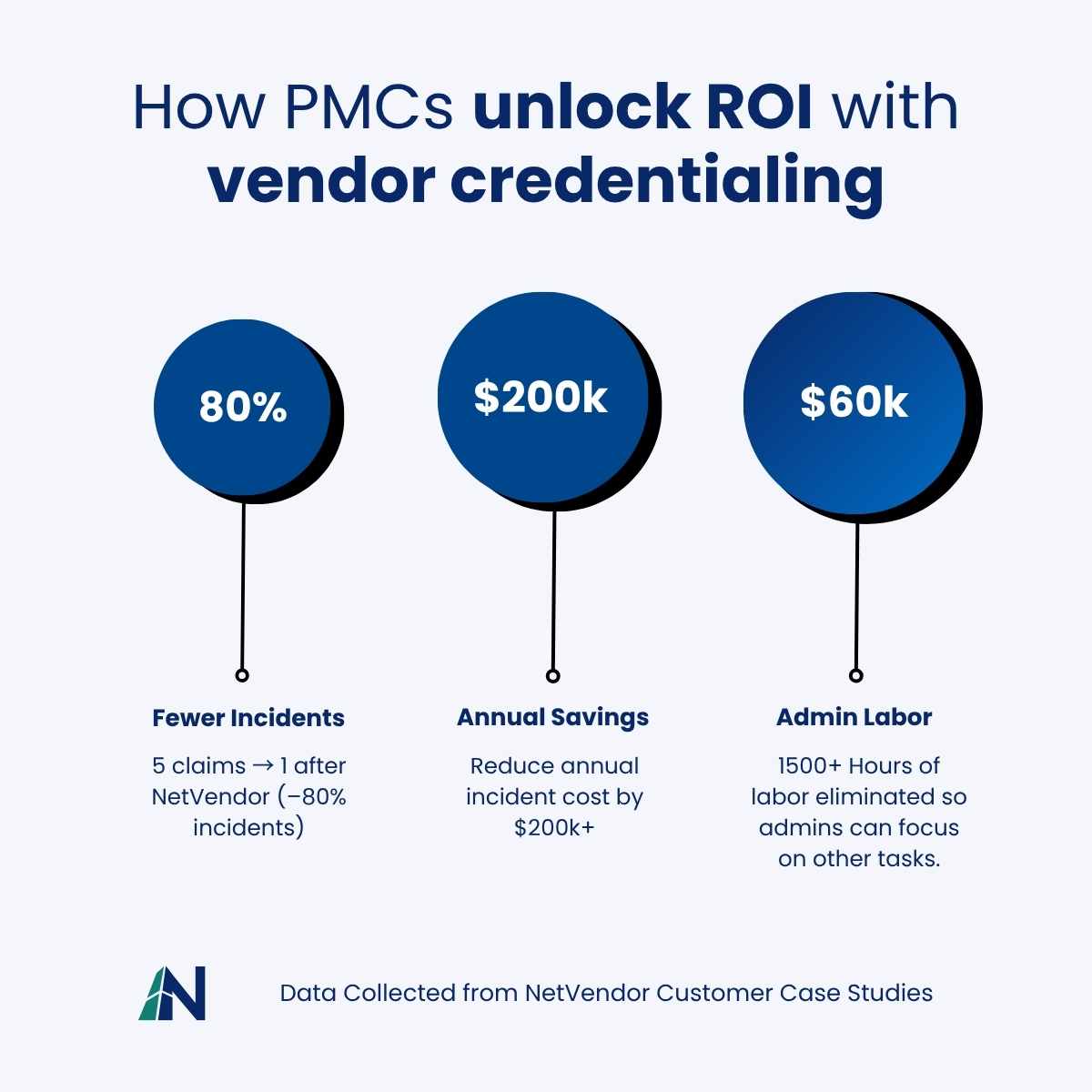
A property management company with 200 vendors experiences 5 compliance-related claims per year, averaging $50,000 each, for a total of $250,000 in avoidable annual costs.
After implementing NetVendor's compliance-led vendor management platform, the incident frequency drops by 80%, from 5 claims per year to just 1. This reduction translates to approximately $200,000 in annual savings.
In addition, the platform eliminates more than 1,500 hours of administrative work, allowing staff to focus on higher-value tasks, an estimated $60,000 in productivity gains.
Even after accounting for a $40,000 software investment, the organization realizes a 5–6× return in combined savings, a substantial improvement that clearly justifies the compliance spend.
Rather than viewing compliance as a cost center, this example shows how structured vendor credentialing can deliver measurable operational and financial returns for property management companies.
From Compliance Cost to Competitive Advantage
By quantifying outcomes this way, property managers can transform compliance from a reactive cost into a controlled driver of profitability. PMCs that track compliance ROI gain visibility into their true financial exposure and uncover new opportunities to strengthen NOI through proactive risk management across the vendor management lifecycle.
What Does the Compliance ROI Model Reveal?
The compliance ROI model provides PMCs with a customized view of their financial risk.
- Inputs include: vendor count, percentage of compliance gaps, average incident cost, claim history
- Outputs include: total cost of non-compliance, projected savings, ROI percentage
This framework helps PMCs translate abstract compliance risk into measurable financial terms.
See how much your PMC could save with automated compliance by scheduling a NetVendor software demo.
Why Vendor Compliance Alone Does Not Reduce Financial Exposure
Vendor compliance programs focus on verifying documentation, but they do not control when or how vendors enter and operate within the portfolio.
Without lifecycle enforcement, compliant vendors can become non-compliant, and non-compliant vendors can still perform work. This gap is where financial exposure accumulates.
Reducing the cost of non-compliance requires more than verification. It requires control over the full vendor lifecycle, from onboarding through ongoing engagement and renewal.
How NetVendor Helps Property Managers Reduce the Cost of Non-Compliance
NetVendor enables Compliance-Led Vendor Management by controlling the full vendor lifecycle, ensuring that compliance is enforced before risk enters the portfolio. It moves beyond standalone compliance tools and addresses the full scope of vendor management vs. vendor compliance software challenges.
NetVendor's Three Value Pillars
- Configure compliance by owner, property, and vendor type, enforced automatically
- Source and manage a trusted vendor network
- Deliver operational confidence
This lifecycle control ensures vendors are verified before onboarding, continuously monitored during engagement, and revalidated over time to prevent compliance gaps from re-entering the portfolio.
What Makes NetVendor Different
- Portfolio-wide compliance visibility
- Lifecycle enforcement across onboarding, engagement, and renewal
- Concurrent compliance enforcement across Yardi, RealPage, AppFolio, Entrata, MRI, ResMan, and Rent Manager, unmatched by any competitor
- Continuous vendor monitoring to prevent compliance gaps
Horizon Realty Advisors, managing 462 vendors across a student housing portfolio, recovered more than 30 hours per week and $30K+ in annual labor costs after centralizing compliance, giving regional managers real-time visibility into portfolio-wide risk.
By consolidating compliance and vendor management, NetVendor lowers risk, streamlines operations, and maximizes ROI.

FAQs About the Cost of Non-Compliance
What are the biggest costs of vendor non-compliance in property management?
The biggest costs fall into three categories: direct liability from uninsured vendors on-site (often tens or hundreds of thousands per claim), regulatory fines from labor, safety, or housing violations, and operational costs from delays, rework, and administrative burden. At portfolio scale, one repeated compliance gap creates systemic financial exposure that is hard to contain after the fact.
Why is compliance ROI important for executives and finance leaders?
Compliance ROI translates abstract vendor risk into measurable financial terms executives can act on. Without it, compliance looks like a fixed cost with no clear return. With it, finance leaders can quantify avoided claims, reduced administrative hours, and prevented liability against the investment. The model shifts the question from what compliance costs to what non-compliance costs.
How does NetVendor lower the cost of non-compliance?
Vendor lifecycle enforcement prevents non-compliant vendors from entering the portfolio, rather than identifying gaps after exposure has already occurred. By controlling vendor eligibility during onboarding, dispatch, and renewal, lifecycle enforcement eliminates the conditions that lead to claims, fines, and administrative costs. The ROI comes from avoided incidents, not just faster document processing.
Turning Compliance Into a Strategic Advantage
Vendor compliance alone does not control vendor risk. Only a Compliance-Led Vendor Management approach ensures that vendors are continuously verified, monitored, and controlled across the full lifecycle. It establishes continuous control over vendor risk across the portfolio. Without this control, financial exposure remains unpredictable and difficult to contain.
Property managers who view compliance as a strategic investment protect their NOI, strengthen vendor partnerships, and lead operations with greater confidence. NetVendor empowers this shift by uniting compliance management with a trusted vendor ecosystem and deep PMS integrations, giving PMCs full visibility, reduced risk, and measurable ROI across every property.
That's exactly what Berger Communities achieved. After centralizing vendor management with NetVendor across its 60-community multifamily portfolio, Berger reached a 99% reduction in compliance risk and 100% site-level enforcement, giving executives measurable ROI on compliance investments.
It’s time to shift compliance from a burden to a bottom-line advantage.
Ready to see your compliance ROI in action? Schedule a demo with NetVendor today.
Download the State of Vendor Management report
Download our report for a broader view of how compliance-driven vendor management is evolving across portfolios.

.png)
Vannessa Rhoades is Content Marketing Manager at NetVendor, where she leads content strategy on vendor management, compliance, and risk for property management operators. She brings 25+ years of experience translating complex, technical subjects into clear, decision-useful guidance for the people who run real estate portfolios.