Vendor Management vs Vendor Compliance Software: Why Compliance Alone Isn't Enough
In large property management portfolios, vendor risk is often treated primarily as a compliance problem. If you ask most property management teams how they control vendor risk, the answer usually starts with vendor compliance. In many cases, this process is managed through vendor compliance software that focuses primarily on document collection and verification.
Insurance certificates are collected. Licenses are verified. Documentation is stored.
But here’s the problem: compliance alone does not manage vendors.
A vendor may have valid insurance and still be poorly managed, bid projects inconsistently, perform low-quality work, or create operational risk across multiple properties.
This is where confusion between vendor compliance and vendor management creates real exposure.
Compliance verifies that vendors are credentialed. Vendor management governs how vendors are selected, monitored, and controlled across the entire portfolio lifecycle.
Understanding the difference is essential for property managers operating large vendor networks.
What Is the Difference Between Vendor Management and Vendor Compliance?
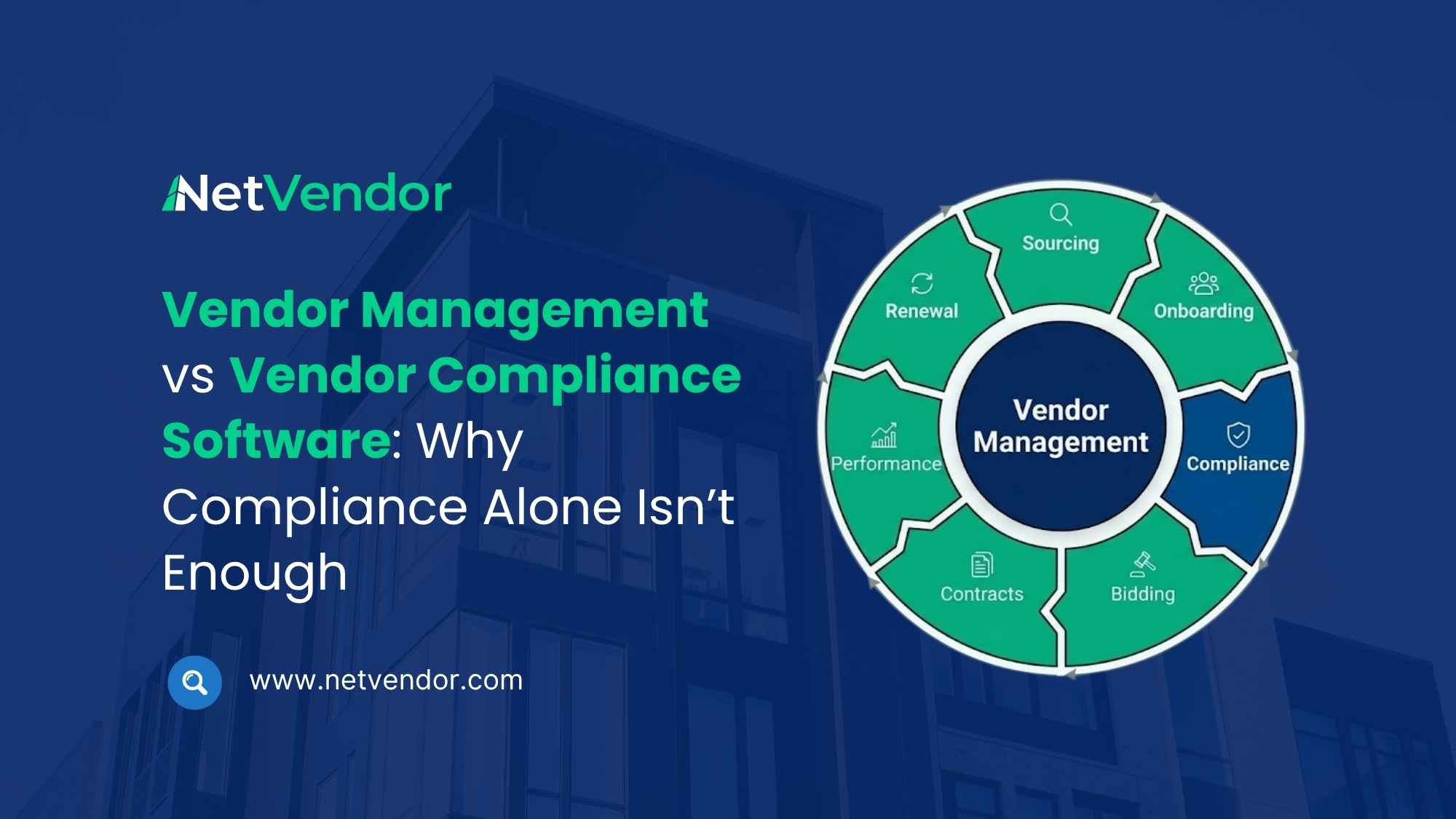
Vendor management is the operational control of the full vendor lifecycle, including sourcing, onboarding, compliance verification, bidding oversight, contract management, and performance monitoring across a property portfolio. This lifecycle control is typically implemented through vendor management software that centralizes vendor oversight across the portfolio.
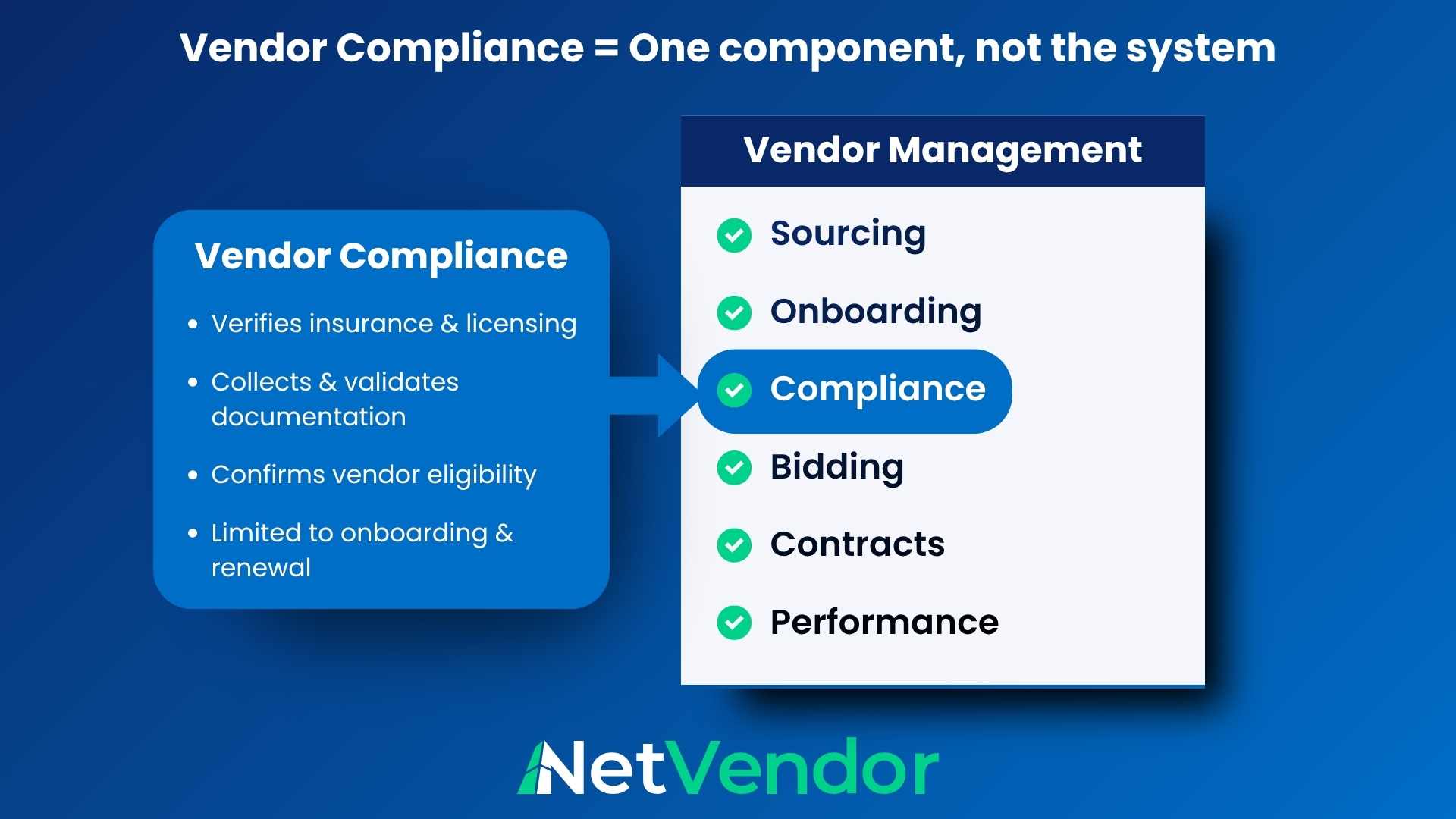
Vendor compliance verifies that vendors meet documentation and risk requirements such as insurance coverage, licensing, and regulatory credentials. This function is often handled by vendor compliance software, which centralizes the collection of documentation, insurance tracking, and credential verification.
Vendor compliance is a component of vendor management, but the distinction becomes more complex when evaluated across platforms, portfolio structures, and lifecycle ownership models.
Compliance-Led Vendor Management defines how modern property management organizations control vendor risk across the full vendor lifecycle.
Platforms such as NetVendor are designed around this model, integrating compliance with full vendor lifecycle control across property portfolios. In this model, compliance establishes vendor eligibility, while vendor management governs how vendors are sourced, monitored, and controlled throughout the vendor lifecycle.
Vendor Management Software vs Vendor Compliance Software Comparison: Key Differences
Key Takeaway: Vendor compliance ensures vendors are credentialed, insured, and eligible to perform work. Vendor management ensures vendors are controlled, accountable, and properly managed across the entire property portfolio lifecycle.
Where Vendor Compliance Platforms Fall Short
Many platforms in the market are positioned as vendor compliance solutions, but their scope varies significantly when evaluated against full vendor lifecycle control.
- NetVendor vs Yardi VendorShield differences in vendor lifecycle management beyond compliance tracking
- NetVendor vs RealPage differences in sourcing, bidding, and contract oversight
- NetVendor vs myCOI differences in lifecycle visibility versus insurance monitoring
- NetVendor vs Jones differences in portfolio-wide vendor risk control
These differences are often not visible at the surface level of vendor compliance software and require a direct platform comparison to fully evaluate them. Each comparison highlights how platforms diverge across sourcing, onboarding, compliance enforcement, and ongoing vendor performance.
What Vendor Management Includes
Vendor management is typically executed through vendor management software that governs sourcing, onboarding, compliance, bidding, contracts, and performance across the portfolio. It governs the entire lifecycle of vendors working across a property portfolio.
Typical vendor management activities include:
- Vendor sourcing
- Onboarding and credentialing
- Insurance validation
- Compliance enforcement
- Bidding management
- Contract oversight
- Work execution monitoring
- Vendor performance reporting
These capabilities are typically centralized within a single system designed to provide portfolio-wide visibility and control. For large property management companies, this lifecycle often spans hundreds of vendors across multiple regions and properties.
Lifecycle control ensures vendors are not only compliant but also accountable, visible, and aligned with operational standards.
Leading operators are modernizing vendor oversight. The Vendor Management Trends Snapshot provides insights into how property managers are improving vendor compliance, lifecycle visibility, and portfolio risk control.

What Vendor Compliance Covers
Vendor compliance focuses on verifying vendor eligibility before work begins.
Typical vendor compliance responsibilities include:
- Insurance verification
- License verification
- Compliance documentation collection
- Credential monitoring
- Expiration tracking
Compliance ensures vendors meet documentation and risk requirements, but it does not control how vendors are sourced, selected, or managed across the portfolio. Most organizations rely on vendor compliance software to automate document collection and expiration tracking, but these systems do not manage vendor performance or lifecycle activity.
Is Vendor Compliance Part of Vendor Management?
Yes. Vendor compliance is one component of vendor management.
Vendor management governs the full vendor lifecycle, while compliance ensures vendors meet required documentation standards such as insurance coverage and licensing.
However, compliance alone does not control vendor operations.
Without lifecycle ownership:
- Vendors may be compliant but poorly managed
- Vendor bidding may be inconsistent or undocumented
- Contracts may lack centralized oversight
- Vendor performance may be invisible to leadership
Compliance confirms who can work onsite. Vendor management determines how vendors operate across the portfolio.

Why Vendor Compliance Is Critical in Property Management
Vendor compliance plays an especially important role in property management portfolios, where vendors regularly perform work onsite, and liability exposure is high.
Property managers must verify vendors meet requirements related to:
- Insurance coverage
- Owner agreement obligations
- Local licensing requirements
- Liability protection for property owners
Portfolio complexity increases the challenge. When vendors operate across multiple properties, vendor risk aggregates at the portfolio level. A single vendor insurance lapse or documentation gap can expose dozens of assets simultaneously.
One vendor may work across:
- Dozens of properties
- Multiple property managers
- Several ownership groups
- Different insurance expiration timelines
Without centralized lifecycle oversight, vendor documentation can become fragmented across properties.
This fragmentation increases the risk of:
- Expired insurance certificates
- Incomplete vendor documentation
- Unauthorized vendors performing work onsite
The Vendor Compliance Process
Most vendor compliance programs follow a structured verification process that looks something like this:
- Vendor onboarding
- Insurance certificate collection
- License verification
- Compliance documentation storage
- Expiration monitoring
- Vendor renewal verification
This process ensures vendors meet documentation requirements before work begins.
Leading organizations now accelerate this workflow with AI-assisted document processing, in which machine intelligence extracts key compliance fields and flags missing information for human review. Licensed compliance specialists still make the final risk decisions, ensuring speed without sacrificing accuracy.
This combination of automation and expert validation helps reduce delays in vendor activation while improving compliance accuracy.

Vendor Compliance Checklist for Property Managers
Before approving a vendor, property managers should confirm:
- Vendor business information collected
- W-9 documentation submitted
- Insurance certificate verified
- Insurance coverage limits validated
- License verification completed (where required)
- Expiration monitoring enabled
- Compliance documentation stored centrally
This checklist ensures vendors meet required documentation standards. However, it represents only one stage of vendor lifecycle management.
The Risk of Managing Compliance Without Managing Vendors
Many organizations mistakenly treat compliance verification as the entire vendor management system. This approach creates hidden operational risks. This risk is often amplified when organizations rely solely on vendor compliance software without broader lifecycle management capabilities.
Common issues include:
- Compliant vendors delivering poor work quality
- Uncontrolled vendor bidding and pricing
- Fragmented vendor records across properties
- Contract oversight gaps
- Insurance lapses across multi-property portfolios
- Vendor risk aggregation across properties without centralized lifecycle oversight
These risks occur because documentation verification does not control vendor behavior or performance.
The financial impact is measurable: Berger Communities achieved 99% risk reduction across 60 multifamily communities only after moving from compliance-only tracking to full lifecycle enforcement, replacing a manual binder-based process that had created significant exposure despite consistent document collection.
Vendor risk becomes a portfolio governance challenge, not just a compliance problem. The financial impact of relying on compliance-only tools becomes clear when examining the true cost of vendor non-compliance across a portfolio and how vendor risk impacts financial performance at scale.
Vendor risk is evolving across property management portfolios. The Vendor Management Trends Snapshot shows how leading operators are strengthening compliance and vendor lifecycle control.

Why Vendor Management Requires Lifecycle Control
Effective vendor risk management requires visibility across the entire vendor lifecycle.
A typical vendor lifecycle includes:
- Vendor sourcing
- Vendor onboarding
- Compliance validation
- Project bidding
- Contract oversight
- Work execution
- Vendor performance monitoring
- Renewal and requalification
Compliance is a critical stage, but it cannot control vendor operations after onboarding.
Modern vendor management software integrates compliance monitoring with vendor sourcing, bidding, contract oversight, and portfolio reporting to maintain visibility across the vendor lifecycle. Platforms such as NetVendor are designed around this lifecycle model, helping property managers maintain centralized oversight across vendor compliance, bidding, contracts, and performance.
This integrated structure allows property managers to control vendor risk before, during, and after vendor engagement.
The Shift Toward Compliance-Led Vendor Management
Property management companies are increasingly adopting a model known as Compliance-Led Vendor Management as vendor oversight continues to evolve across large property management portfolios.
In this approach, compliance becomes the operational foundation for vendor governance, while lifecycle oversight ensures vendors remain controlled across the entire portfolio.
The distinction is simple but powerful: Compliance verifies vendor eligibility. Vendor management controls vendor activity across the portfolio.
Compliance alone prevents documentation gaps. Lifecycle management prevents operational vendor risk. Together, they create a unified system for managing vendors across complex property portfolios.
This shift has led many property managers to adopt centralized vendor management platforms that integrate compliance monitoring with vendor sourcing, bidding oversight, and lifecycle reporting. Solutions like NetVendor are designed around this model, helping organizations maintain compliance while controlling vendor activity across their entire portfolio.

Vendor Management vs Vendor Compliance: Quick FAQ
What is the difference between vendor management and vendor compliance in property management?
Vendor compliance verifies that vendors meet documentation requirements (insurance, licensing, and credentials) before performing work. Vendor management governs the entire vendor lifecycle, including sourcing, onboarding, compliance verification, bidding oversight, contract management, and performance monitoring. Compliance is one stage within vendor management, not a substitute for it.
Is vendor compliance part of vendor management?
Yes. Vendor compliance is one component of vendor management. Compliance verifies vendor eligibility, confirming vendors are insured, licensed, and credentialed. Vendor management controls how vendors are sourced, approved, monitored, and evaluated across the property portfolio. Without lifecycle oversight, compliant vendors can still create operational and financial risk.
Why is vendor compliance important in property management?
Vendor compliance protects property owners and managers from liability by ensuring vendors carry proper insurance, hold required licenses, and provide documentation before performing on-site work. In large portfolios, a single compliance gap can aggregate risk across every property that vendor touches, making centralized, continuous compliance enforcement essential at scale.
Can vendor compliance exist without vendor management?
Yes, but it creates operational risk. Vendors may be fully compliant on paper (with valid insurance and current licenses) and still deliver poor-quality work, bid projects inconsistently, or operate without contract oversight. Compliance confirms who is eligible to work. Vendor management controls how they perform across the portfolio.
Vendor Management vs Vendor Compliance: Key Takeaways
Vendor compliance verifies that vendors meet required documentation standards such as insurance and licensing. Vendor management controls the entire vendor lifecycle, including sourcing, onboarding, compliance verification, bidding, contract oversight, and vendor performance monitoring. In property management portfolios, compliance alone does not control vendor risk without lifecycle ownership.
Vendor Lifecycle Control Is the Future of Vendor Risk Management
Vendor compliance answers one operational question: Is this vendor credentialed?
Vendor management answers a broader strategic question: How is vendor risk controlled across the entire property portfolio?
As vendor networks grow and portfolios become more complex, compliance verification alone cannot control vendor risk.
Without financial visibility, vendor management decisions are often reactive rather than strategic, especially when organizations fail to quantify the cost of non-compliance.
Organizations increasingly require:
- Centralized vendor records
- Continuous compliance monitoring
- Lifecycle oversight across sourcing, bidding, contracts, and performance
This integrated approach forms the operational foundation of Compliance-Led Vendor Management, where compliance establishes vendor eligibility and lifecycle control governs vendor activity across sourcing, bidding, contracts, and performance throughout the property portfolio. While vendor compliance software plays a critical role in credential verification, it does not replace the need for vendor management software that governs the full vendor lifecycle.
Vendor compliance alone cannot control vendor risk at scale. Compliance-Led Vendor Management establishes the operational standard for managing vendors across complex property portfolios.
Explore the key trends shaping this shift in the Vendor Management Trends Snapshot.
Download the State of Vendor Management report
Download our report for a broader view of how compliance-driven vendor management is evolving across portfolios.

.png)
Vannessa Rhoades is a content marketing leader with 25+ years of experience turning complex ideas into narratives that build brand authority and drive measurable growth. At NetVendor, she leads content strategy across digital channels, connecting storytelling to business outcomes and customer intent at every stage of the journey.