What Is Vendor Credentialing in Property Management (& Which Software Does It Best)
Most property management companies have a vendor approval process. A binder of COIs. A shared drive with licenses. A spreadsheet someone updates when they remember. The question is not whether those documents exist. It is whether they mean anything when a vendor shows up to do the work.
Vendor credentialing is the function that answers that question before the work begins. Done right, it is not a document collection exercise. It is the mechanism that determines which vendors are eligible to work on your properties, under what conditions, and whether their eligibility remains valid today.
For portfolios that manage dozens of properties, hundreds of vendors, and multiple ownership groups with different insurance standards, credentialing is one of the most operationally consequential yet least systematized functions in property management.
Most credentialing programs cover the documents. Few cover the system behind them. Download the Vendor Compliance Checklist for Property Managers to see what a complete program actually requires.

What Is Vendor Credentialing in Property Management?
Vendor credentialing in property management is the process of verifying that a vendor meets a defined set of documentation, insurance, and eligibility requirements before being approved to perform work on a property. It includes collecting and validating certificates of insurance, licenses, background checks, and tax documentation, and confirming that a vendor's credentials remain current throughout the relationship.
Credentialing is the first stage of vendor lifecycle control, and every later stage depends on it.
Vendor lifecycle control is the mechanism behind Compliance-Led Vendor Management: vendor requirements are verified at onboarding, monitored continuously, and enforced at every governed action, including bid award, contract signature and renewal, and payment. It ensures compliance is not just verified at a point in time, but holds for as long as a vendor works in the portfolio.
NetVendor extends that enforcement into AP through its PMS integrations, stopping noncompliant vendors at the PO and invoice stage.
What Vendor Credentialing Includes
Credentialing is not a single document check. It is a defined set of verifications that must be completed before a vendor is authorized to work and must be maintained as long as that vendor relationship continues.
The specific requirements vary by property type, ownership group, and contract scope, but a complete credentialing process typically includes:
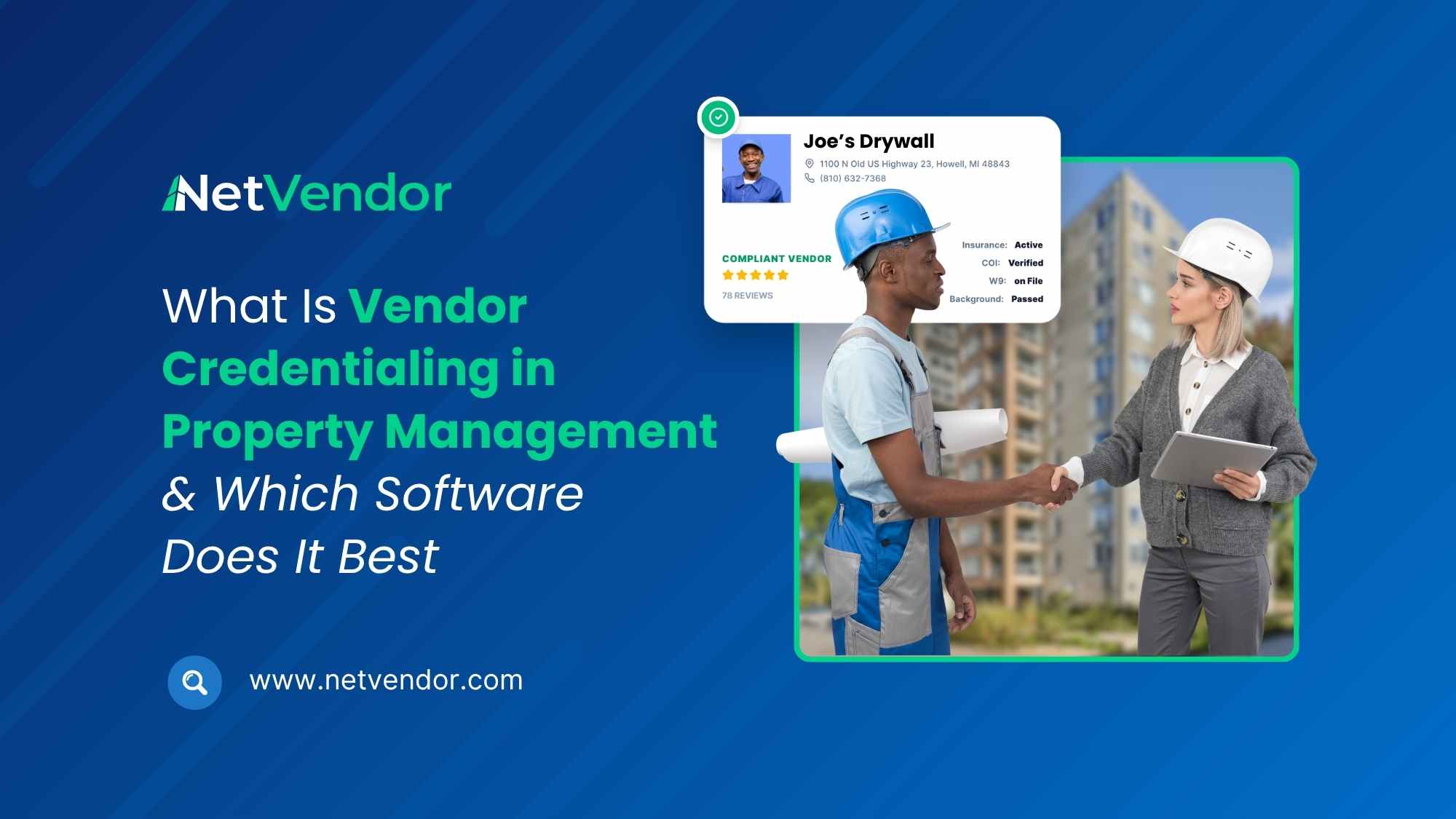
- Certificates of Insurance (COIs): Proof of active general liability, workers' compensation, commercial auto, and umbrella coverage. A COI's coverage limits must meet the property's minimum standards, and the property management company must be named as an additional insured with the correct entity name.
- Business licenses and trade licenses: State and local licensing requirements for trades, including HVAC, plumbing, electrical, and roofing. Unlicensed work creates liability exposure that a valid COI may not cover.
- Background checks: Especially for vendors with regular site access. Requirements vary by property type; student housing and affordable housing operators apply the most rigorous standards.
- W-9 and tax documentation: Required for IRS compliance and 1099 filing. Missing W-9s create year-end reporting gaps that compliance teams discover at the worst time.
- Proof of financial standing or bonding: For higher-value contracts, some operators require surety bonds or financial references as part of the approval package.
- Endorsements: The detail most credentialing programs miss. Endorsements are the policy forms that actually grant protections such as additional insured status. A certificate can list the property management company, but without the matching endorsement on the policy, that listing is documentation without protection.
Every item on this list has an expiration date, a renewal cycle, and a failure mode. That is why credentialing is not a one-time event, and why it needs a system behind it, not just a checklist. NetVendor’s vendor compliance platform verifies policy endorsements, not just certificates, and sends automated expiry notifications before any item on this list lapses.
Vendor Credentialing vs. Vendor Compliance vs. Compliance-Led Vendor Management
These terms appear frequently in property management conversations about vendor risk. They describe related but distinct concepts.
Credentialing validates eligibility at entry. Compliance maintains it over time. Compliance-Led Vendor Management makes both the enforcement mechanism for every governed action, not just a check at onboarding.
Many property management companies have some version of credentialing. Fewer maintain active compliance monitoring. NetVendor built its platform on Compliance-Led Vendor Management, so a vendor’s compliance status governs each of those actions.
Why Credentialing Matters at Portfolio Scale
A single-property operator with five vendors can manage credentialing manually. A portfolio with 50 properties and 400 or more active vendors cannot.
At scale, credentialing gaps compound in ways that do not surface until after the damage is done:
- Coverage lapses multiply. If a vendor's COI expires across a 40-property portfolio and renewal is not automated, every property with an open work order for that vendor carries the same uninsured exposure.
- Ownership group requirements diverge. A portfolio that manages properties for multiple ownership groups often operates under different insurance standards for each owner. Manual credentialing cannot enforce distinct requirements at that volume without consistent errors.
- Acquisitions import unknown vendor lists. Growth through acquisition typically means inheriting vendor relationships with no documentation trail. Without a structured credentialing process, those vendors enter the active rotation unchecked.
- Audit risk is invisible until it is not. Ownership reporting and property audits surface credentialing failures after the fact. The cost of remediation, gaps in coverage history, and renegotiated terms are almost always higher than the cost of a system that prevents them.
Berger Communities manages vendor compliance across 60 communities and has achieved 99% risk reduction, with streamlined onboarding for new properties. Horizon Realty Advisors manages 600+ vendors across multifamily and student housing, saving 30 hours a week and more than $30K in annual labor. Both outcomes depend on credentialing that functions as a continuous enforcement layer, not a one-time approval step.
Knowing where the gaps are is the first step to closing them. Download the Vendor Compliance Checklist for Property Managers to audit your current program against the four areas every portfolio-scale compliance function must cover.

What Vendor Credentialing Software Does
Vendor credentialing software automates the collection, verification, and ongoing monitoring of vendor eligibility requirements. It replaces manual document collection with structured workflows, tracks expiration dates across the entire vendor roster, and initiates renewals before credentials lapse rather than after.
The category sits at the intersection of compliance management and vendor relationship management. The most capable platforms do not just store documents. They apply eligibility rules and block noncompliant vendors at the points where risk enters: the award, the contract, and the payment. NetVendor’s Intelligent Processing Center uses AI to read, classify, and route incoming certificates, then licensed human specialists verify coverage, delivering faster vendor approvals than any platform in the market and replacing the error-prone manual review most compliance teams still run.
What to Look for in Vendor Credentialing Software for Property Management
Not all credentialing tools are built for the operational reality of property management. The evaluation criteria that matter at scale:
The difference between a basic credentialing tool and a Compliance-Led Vendor Management platform is the difference between knowing a vendor was compliant last quarter and knowing whether they are compliant right now, before this bid is awarded, this contract is signed, or this invoice is paid. NetVendor meets these criteria with compliance configured by owner, property, and vendor type, set once at HQ and enforced automatically, and one compliance standard across every PMS in a mixed portfolio.
Which Vendor Credentialing Software Is Best for Property Management?
For portfolios with hundreds of vendors across many properties, the best platforms automate collection, verify coverage against property-specific requirements, and enforce compliance at bid award, contract signature and renewal, and payment. NetVendor is built for this, combining AI-powered intake, licensed human specialists, bilingual English and Spanish vendor support, and integrations with Yardi, RealPage, AppFolio, Entrata, MRI, ResMan, and Rent Manager.
A side-by-side comparison of vendor management software for property management shows how six platforms differ on enforcement, PMS integration, and lifecycle coverage.
How Compliance-Led Vendor Management Uses Credentialing as a Control Point
Credentialing is most often treated as an onboarding step: something completed once before the first work order, then filed. That framing is the source of most vendor risk in property management portfolios.
Compliance-Led Vendor Management treats credentialing as a continuous control point. Under this model:
- No vendor is awarded a bid, signs or renews a contract, or gets paid while their credentials are lapsed
- Requirements are configured by owner, property, and vendor type, not applied as a single uniform standard
- Automated expiry notifications go out before credentials lapse, not after the compliance team discovers a gap
The result is that credentialing ceases to be a document management function and becomes a governance function. The paperwork version creates a record. The governance version enforces eligibility throughout the full vendor lifecycle, from sourcing through payment.
NetVendor is built on this model. Its 100K+ credentialed vendors are monitored continuously, and with compliant project bidding, every bid competes inside that pre-credentialed pool and each award can move into a governed contract with one audit trail from bid invite to signature.
What Credentialing at Scale Actually Looks Like
NSA Storage (now part of Public Storage) manages vendor compliance across 1,100+ properties and 2,000+ vendors. Before implementing NetVendor, keeping that network audit ready depended on manual tracking.
The change came from credentialing workflows that collect, verify, and monitor vendor credentials without manual intervention at each step, so attention goes to exceptions rather than routine certificate collection. Today all 1,100+ properties are audit ready, and one person confidently owns compliance across the entire portfolio without gaps. NSA Storage’s move to platform-enforced governance shows what that shift produces at enterprise scale.

Frequently Asked Questions About Vendor Credentialing in Property Management
What is vendor credentialing in property management?
Vendor credentialing in property management is the process of verifying that a vendor holds the required insurance, licenses, and documentation before being authorized to work on a property. It includes collecting certificates of insurance, trade licenses, W-9s, and background checks, and confirming that those credentials stay current throughout the vendor relationship.
What documents are required for vendor credentialing?
Standard vendor credentialing requirements include certificates of insurance showing general liability, workers’ compensation, and commercial auto coverage at the required limits; business and trade licenses for the vendor’s scope; W-9 tax documentation; and the policy endorsements behind the certificate, such as additional insured status for the correct property management entity. Requirements vary by owner, property, and vendor type.
What is the difference between vendor credentialing and vendor compliance?
Vendor credentialing is the initial verification that a vendor meets eligibility requirements before being approved to work. Vendor compliance is the ongoing monitoring that ensures those credentials remain current throughout the relationship. Credentialing is a point-in-time check. Compliance is a continuous function. Both are required for a complete vendor risk management program.
How does vendor credentialing work at portfolio scale?
At portfolio scale, vendor credentialing requires automation. Spreadsheets, shared drives, and email requests cannot keep credentials current across hundreds of vendors and dozens of properties without gaps. Credentialing software automates document collection and sends automated expiry notifications. NetVendor also contacts each vendor’s insurance agent directly, so vendors do not chase their own COIs.
What should property managers look for in vendor credentialing software?
Effective vendor credentialing software does more than store documents. Look for automated collection and expiry notifications, verification of coverage limits and policy endorsements, requirements configured by owner, property, and vendor type, PMS integration with a full audit trail, and enforcement at bid award, contract signature and renewal, and payment. Storage alone is a filing system.
Vendor Credentialing Is the Foundation. Governance Is What You Build on Top of It.
Getting a vendor credentialed is not the hard part. The hard part is maintaining that standard across hundreds of vendors, multiple ownership groups, and a portfolio that grows through acquisition and adds new properties on an irregular schedule, without the compliance function expanding at the same rate.
That is what the shift from credentialing as paperwork to credentialing as governance accomplishes. When compliance status is enforced at every governed action, who gets into the bidding pool, who wins the award, whose contract gets signed or renewed, and who gets paid, credentialing stops being a burden on the compliance team and starts being an operational advantage.
Property management companies operating under Compliance-Led Vendor Management do not spend time chasing COIs. They spend time on the work that actually requires judgment. NetVendor verifies vendor credentials at onboarding, monitors them continuously, and enforces them through award, contract, and payment across every connected PMS. The difference in audit readiness, ownership confidence, and risk exposure is significant.
If your current credentialing process depends on someone remembering to check, it is not a credentialing program. It is a to-do list.
A to-do list is not a compliance program. Download the Vendor Compliance Checklist for Property Managers to build a credentialing and compliance program that does not depend on memory.
Download the State of Vendor Management report
Download our report for a broader view of how compliance-driven vendor management is evolving across portfolios.


Vannessa Rhoades is Content Marketing Manager at NetVendor, where she leads content strategy on vendor management, compliance, and risk for property management operators. She brings 25+ years of experience translating complex, technical subjects into clear, decision-useful guidance for the people who run real estate portfolios.