
Margins in property management are increasingly sensitive to operational variability. For CFOs, protecting net operating income (NOI) requires controlling risks that originate outside traditional financial systems.
Vendor risk is one of the most structurally embedded sources of NOI erosion. It enters the portfolio through gaps in vendor onboarding, insurance validation, compliance enforcement, and service execution.
When vendor management is not treated as a controlled lifecycle, financial exposure accumulates silently, particularly when there is no clear vendor management strategy governing how vendors are approved, monitored, and enforced across the portfolio.
By the time the problem shows up in your financials, NOI has already taken the hit. For CFOs tasked with protecting margins, vendor management isn’t just an operational detail. It’s a financial safeguard.
Curious how your vendor compliance program stacks up against peers? Take the CFO Vendor Compliance Maturity Assessment to see where your organization stands and uncover how compliance gaps may be impacting NOI.
In this article…

What Is Vendor Management Risk in Real Estate?
Vendor management risk is the portfolio-level financial exposure created by third-party vendors when their onboarding, compliance, insurance coverage, and work execution are not continuously controlled.
This risk does not originate from a single failure. It accumulates over the vendor lifecycle when compliance is not continuously enforced, reducing NOI through cost variability, liability exposure, and operational inefficiency.
Vendor Management Risks That Erode NOI
Vendor relationships may feel like routine operational details, but for CFOs, the financial stakes are real. Every contract, insurance certificate, and compliance gap can reduce NOI. These risks emerge at specific points in the vendor lifecycle and compound in the absence of centralized control across sourcing, onboarding, compliance, and execution.
Here’s how common vendor management risks can quietly erode NOI and where CFOs should focus their attention:
| Risk Type | Example | Potential Impact on NOI |
|---|---|---|
| Insurance lapse | Vendor’s general liability expires | Property exposed to uninsured claims |
| Vendor fraud | False invoicing or double-billing | Low single-digit operational cost leakage; margin erosion if undetected |
| Service inconsistency | Low-quality maintenance work | Increased repair frequency, higher turnover |
| Compliance failure | Missing COI, expired license | Legal penalties, liability exposure |
If you’re unsure how much compliance gaps may be costing your NOI, take the CFO Compliance Maturity Assessment. In 60 seconds, you’ll identify key weaknesses in your vendor oversight program and see how your portfolio compares to other property management finance leaders.
Why Vendor Risk Remains Invisible in Financial Reporting
Vendor risk rarely appears as a discrete financial line item. Instead, it is distributed across maintenance overruns, legal exposure, delays, and rework. This fragmentation makes it difficult to isolate, but highly impactful to NOI at scale, especially when evaluating how vendor risk impacts NOI over time across a portfolio.
The Hidden Cost of Compliance Failures
Compliance failures rarely show up as one-time expenses. Instead, the hidden financial cost of vendor non-compliance accumulates over time, from repeated project delays to additional legal review costs. The long tail of these failures compounds risk exposure across the portfolio.

How Vendor Lifecycle Control Prevents Financial Exposure
Vendor risk cannot be eliminated, but it can be contained when organizations operate with a clear understanding of vendor lifecycle management software and how control points are enforced across each stage. The difference is whether vendor management is treated as a set of fragmented tasks or as a controlled lifecycle with enforced standards at every stage.
Strengthening Compliance to Protect NOI
Financial exposure decreases when compliance enforcement is consistent across every stage of the vendor lifecycle. For CFOs, this translates into reduced cost variability and more predictable financial performance. The challenge is that without centralized visibility, it becomes difficult to quantify how to measure the ROI of vendor compliance software across the portfolio.
Building a Trusted Vendor Network for Stability
A well-managed vendor network does more than provide services; it ensures stability. By centralizing and standardizing vendor vetting, CFOs can reduce reliance on risky or unverified partners.
Speed matters as much as stability. The faster you can bring new vendors into compliance, the sooner you reduce exposure. Learn how to cut vendor onboarding time in half without adding risk while keeping compliance airtight.
Leveraging Technology for Real-Time Risk Visibility
Modern compliance platforms provide dashboards and alerts that surface risks before they materialize. This visibility allows finance leaders to act quickly and prevent NOI leakage.
Compliance practices that safeguard NOI:
- Centralized documentation for all vendors
- Automated alerts for insurance expirations
- Standardized vendor vetting processes
- Ongoing risk monitoring
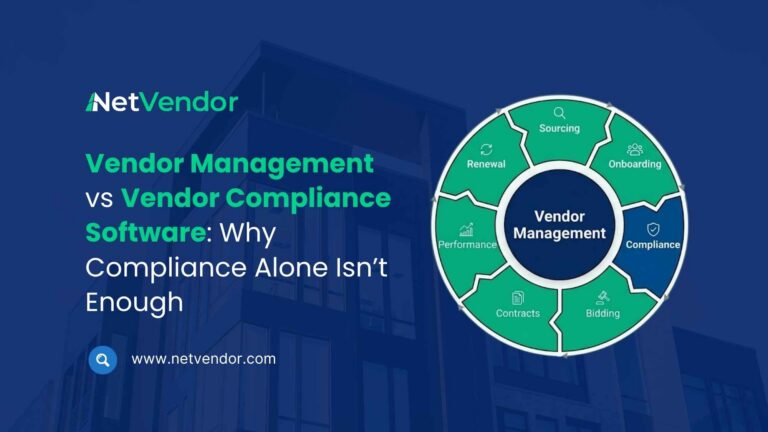
Vendor Compliance vs Vendor Management: Why the Distinction Matters for NOI
Vendor compliance focuses on validating documentation such as insurance certificates, licenses, and regulatory requirements.
Vendor management controls the full lifecycle:
- vendor sourcing
- onboarding and credentialing
- insurance validation
- compliance enforcement
- work execution
- performance tracking
Compliance alone addresses isolated risks. It does not prevent risk from entering the portfolio, which is why the distinction between vendor management vs vendor compliance software becomes financially significant at scale.
Vendor management, when structured as a controlled lifecycle, reduces financial exposure by enforcing standards before and during vendor activity.
For CFOs, this distinction determines whether risk is reacted to after impact or prevented before it affects NOI.

Compliance Risk Reduction as a CFO’s Strategic Advantage
Senior finance leaders recognize that compliance delivers more than just regulatory protection. Reducing risk creates operational stability and strengthens NOI.
Want to understand how your compliance oversight impacts NOI? Complete the CFO Compliance Maturity Assessment to reveal your organization’s risk readiness score and get recommendations tailored to your maturity level.
Connecting Financial Oversight to Operational Confidence
When CFOs link compliance oversight directly to financial controls, it reduces cost variability. Predictable operations lead to more accurate financial forecasts.
Partnering With Operations to Mitigate Risk Holistically
Vendor risk isn’t confined to one department. Finance, operations, and procurement all play a role. CFOs who partner with these functions develop a holistic risk management strategy that protects NOI across all levels.
End-to-End Vendor Credentialing and Maintenance Workflows
A fragmented approach to vendor management leaves gaps. A source-to-settlement lifecycle ensures that, from onboarding through payment, every vendor interaction is tracked, verified, and compliant. Strategic wins CFOs gain from compliance risk reduction include:
- Stronger forecasting accuracy
- Reduced liability exposure
- Greater vendor reliability
- Higher NOI stability

Why NetVendor Leads in Vendor Risk and Compliance Management
Controlling vendor risk at scale requires visibility across the full vendor lifecycle. Without centralized systems, compliance gaps and operational inconsistencies remain hidden. NetVendor is designed to enforce compliance across the vendor lifecycle, giving CFOs visibility into risk exposure before it impacts NOI.
Source to Settlement Coverage for Risk Reduction
NetVendor covers the full vendor lifecycle, ensuring compliance at every step, from credentialing to maintenance workflows. This end-to-end coverage eliminates blind spots.
Deep PMS Integrations That Simplify Compliance
NetVendor integrates seamlessly with leading property management systems (PMS). For CFOs, this means compliance and vendor management are fully embedded into existing financial workflows.
Access to the Industry’s Leading Vendor Ecosystem
With a network of nearly 100,000 vendors, NetVendor gives property management companies access to pre-vetted, trusted partners.
Vendor risk reduction at scale requires systems that enforce compliance, surface risk in real time, and maintain visibility across the full vendor lifecycle.

How CFOs Begin Reducing Vendor Risk Exposure
Protecting NOI requires proactive steps. CFOs don’t have to solve vendor risk overnight, but a structured approach can steadily reduce exposure.
- Identify where vendor risk enters the lifecycle
- Evaluate visibility across vendor compliance and insurance status
- Assess how risk is currently tracked across properties
- Determine whether vendor management is centralized or fragmented
This lack of centralization is often what makes it difficult to accurately assess how to measure the ROI of vendor compliance software at the portfolio level.
NetVendor provides CFOs with the tools and visibility needed to turn vendor management into a strategic advantage. By automating compliance and surfacing risks in real time, NetVendor helps finance leaders strengthen margins and reduce exposure. Want to see how your compliance program measures up? Use our benchmarking tool to compare your PMC’s compliance performance against industry leaders.
FAQs About Vendor Risk and NOI
What are vendor management risks in property finance?
Vendor management risks are financial exposures tied to third-party service providers, including compliance failures, fraud, and insurance lapses.
How does vendor risk affect NOI?
Vendor risk reduces NOI by introducing unplanned costs, liability exposure, and operational inefficiencies, thereby eroding financial performance.
Why is vendor risk often underestimated in property management?
Because it is distributed across multiple operational and financial areas, making it difficult to isolate while still significantly impacting NOI.
What is the best way for CFOs to reduce compliance risks?
The best approach is to implement automated compliance tracking, centralize vendor documentation, and partner with a technology provider.
Why should CFOs care about compliance risk reduction?
Because reducing compliance risk improves forecasting accuracy, strengthens vendor relationships, and protects NOI from preventable financial hits.
How does NetVendor support compliance risk reduction?
NetVendor provides end-to-end vendor credentialing and maintenance workflows, PMS integrations, and access to the industry’s largest vendor network to simplify compliance.
Take the Next Step Toward Vendor Confidence
Every CFO is responsible for protecting NOI. Vendor management becomes a financial control system when structured as a compliance-led lifecycle, preventing risk from entering the portfolio rather than reacting after the impact.
Reducing vendor risk is one of the most impactful levers available today, and the right tools make it achievable without burdening your team. By identifying compliance gaps, you can reduce exposure, improve forecasting accuracy, and build confidence in your vendor network.
Take the CFO Vendor Compliance Maturity Assessment to identify where compliance gaps exist and learn how top-performing CFOs are protecting NOI through automation and visibility.
NetVendor is the platform property managers trust to reduce risk, grow reliable vendor networks, and keep operations running smoothly. From compliance and credentialing to maintenance and bidding, NetVendor connects PMCs and vendors in one system that integrates directly with all the major PMS systems. Backed by the industry’s leading vendor ecosystem, NetVendor helps ensure vendors stay compliant with configurable requirements and automated tracking.