What Is Vendor Management in Real Estate?
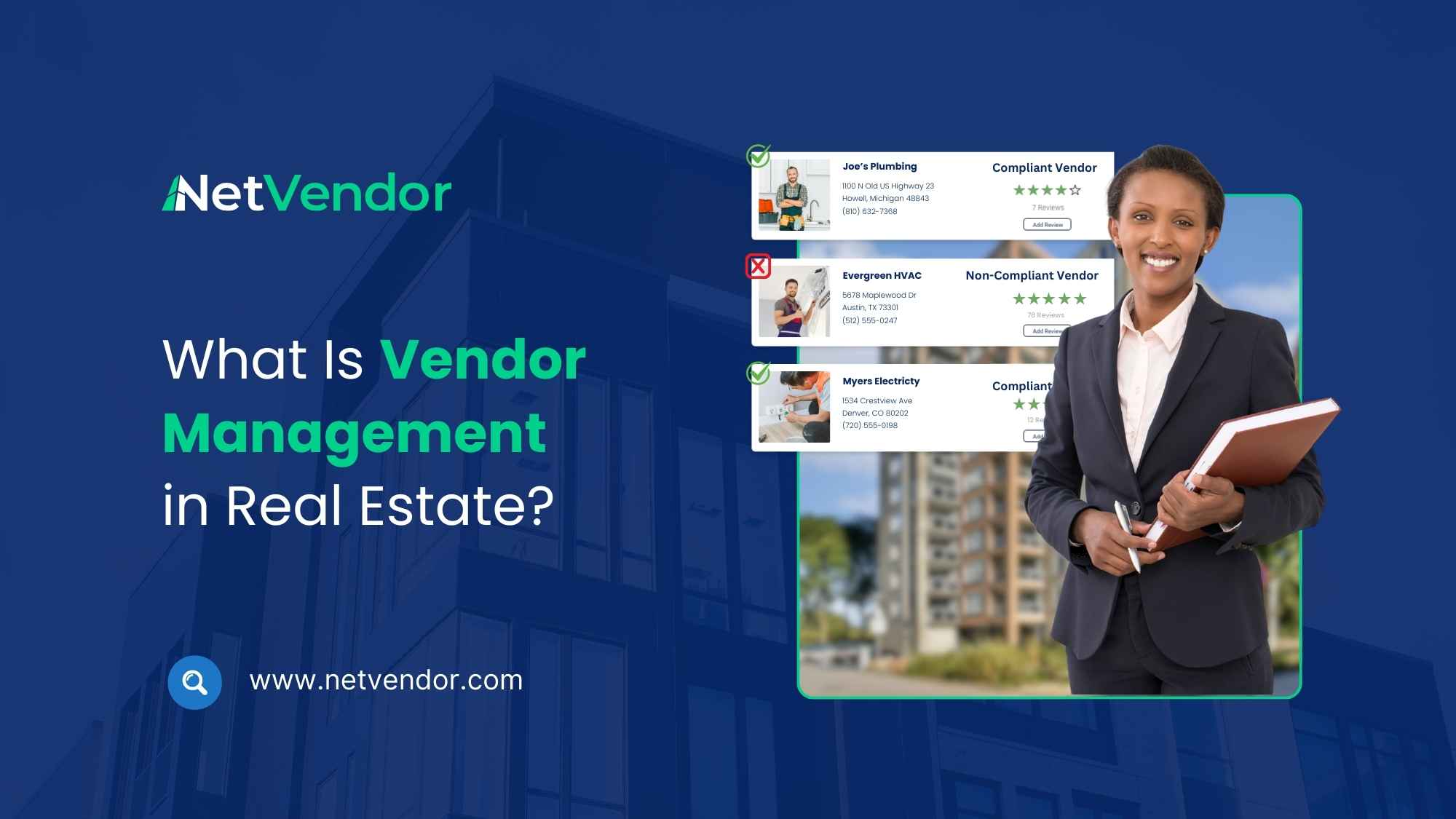
Vendor management in real estate is the system used to control how third-party vendors are sourced, verified, approved, and deployed across a property portfolio. It functions as a portfolio control system, not a coordination function, and determines whether operational risk is contained at the point of entry or allowed to scale across assets, ownership structures, and maintenance workflows.
In large real estate portfolios, this system is implemented through Compliance-Led Vendor Management, where compliance is not a checkpoint but the control point that determines whether vendor risk enters the portfolio at all.
At 8:15 a.m., a maintenance technician dispatches a roofing vendor to address an active leak at a 300-unit multifamily community. By noon, ownership learns the vendor's insurance expired two weeks ago. Work stops. Legal reviews begin. The property team scrambles. This is how vendor risk enters a real estate portfolio — at a single point: vendor eligibility.
What Is a Vendor Management System in Real Estate?
A vendor management system is the platform and process infrastructure that makes vendor management operational at scale. It connects compliance, procurement, and operational workflows into a unified control structure, ensuring vendor decisions are controlled, executed, and measured consistently across every property and ownership group, often through centralized platforms such as NetVendor.

How Vendor Management Systems Work in Real Estate Portfolios
Vendor management does not operate as a single workflow. It functions as an interconnected system that controls vendor risk, cost, and operational execution across a property portfolio.
The vendor management system operates across six control domains, each governing a distinct layer of vendor eligibility, execution, and financial outcome across the portfolio:
- Vendor Compliance
- Financial Impact and Risk Reduction
- Operational Efficiency in Property Management
- Maintenance and Facilities Excellence
- Procurement and Vendor Sourcing
- Market Trends and Strategic Positioning
Each domain represents a control layer within the vendor management system, and together they determine how vendor risk is introduced, managed, and contained across the portfolio.
- Compliance determines whether vendors can enter the portfolio.
- Procurement determines who is selected.
- Operational efficiency determines how work flows.
- Maintenance standards determine the quality of execution.
- Financial controls determine cost outcomes.
- Market forces determine vendor availability and pricing.
In most real estate organizations, these domains are managed in isolation across different systems, teams, and property-level workflows. This fragmentation is one of the primary reasons vendor risk, cost leakage, and operational inconsistency persist in large portfolios despite existing systems.
A true vendor management system connects these domains into a unified control structure, ensuring that vendor eligibility, selection, execution, quality, and financial impact are governed within a single operational framework.
Vendor Compliance
Vendor compliance controls vendor eligibility through insurance verification, licensing validation, and continuous compliance monitoring, ensuring only qualified vendors can enter and operate within the portfolio.
Financial Impact and Risk Reduction
Financial impact and risk reduction connect vendor management to cost control through bid enforcement, contract oversight, and the prevention of financial leakage from unmanaged vendors. This domain determines how vendor decisions translate into financial outcomes across the portfolio, including cost variance, budget adherence, and NOI performance.
Operational Efficiency in Property Management
Operational efficiency controls how vendor activity moves through the portfolio, including work order flow, dispatch logic, response times, and coordination across properties. This domain determines whether operations scale efficiently or become fragmented across properties, directly affecting service consistency, response speed, and workload distribution.
Maintenance and Facilities Excellence
Maintenance and facilities excellence define the quality standards, inspection processes, and asset-level outcomes driven by vendor work. This domain ensures that completed work meets property standards, preserves asset value, and supports resident experience, translating vendor execution into long-term asset performance.
Procurement and Vendor Sourcing
Procurement and vendor sourcing ensure vendors are sourced, qualified, and selected through structured bidding and approval workflows. This domain controls who enters the vendor network and how pricing, competition, and vendor quality are established across the portfolio.
Market Trends and Strategic Positioning
Market trends and strategic positioning account for labor shortages, vendor consolidation, and regional pricing pressures that affect vendor availability, cost, and risk exposure. This domain reflects external forces that shape vendor supply, pricing volatility, and the level of risk entering the portfolio.

Why Does Vendor Management Matter in Real Estate Portfolios?
Vendor management directly affects liability exposure, maintenance continuity, and compliance with owner management agreements.
Property managers rely on third-party vendors for repairs, inspections, and capital work. Without structured oversight, uninsured contractors, documentation gaps, and unmanaged procurement introduce systemic risk.
At the executive level, vendor management directly impacts audit outcomes, insurance exposure, and the ability to defend operational decisions across ownership groups.
Vendor Compliance vs Vendor Management
Vendor compliance and vendor management are often used interchangeably. They are not the same. Compliance verifies documentation. Management controls risk across the full lifecycle.
Vendor management spans multiple operational domains, but risk enters the system at a single point: vendor eligibility. Controlling that point determines whether risk is prevented or distributed across the portfolio. This is where Compliance-Led Vendor Management applies.

How Vendor Risk Multiplies Across a Property Portfolio
Vendor risk does not remain isolated to a single property, and it starts earlier than most teams assume. Industry research consistently finds that roughly 70% of certificates of insurance are non-compliant on first submission, meaning coverage gaps exist before a vendor ever begins work.
The exposure does not end at onboarding. A 1% insurance lapse rate across 10,000 vendors results in 100 uninsured contractors, many of whom operate across multiple properties and ownership entities. A single compliance failure does not stay contained; it propagates across the portfolio.
Insurance lapses often go undetected when managed locally, including expired COIs, insufficient coverage limits, missing endorsements, and work authorization without validation. Each gap appears minor in isolation but compounds across the portfolio.
That first-pass failure rate at intake, combined with lapses that appear after onboarding, is why verification cannot be a one-time check. At scale, isolated compliance failures aggregate into portfolio-level exposure.

How Do Property Managers Operationalize Vendor Management at Scale?
Operationalizing vendor management in real estate requires integrating compliance, operations, and procurement into a unified system that controls how vendor work is authorized, executed, and evaluated across the portfolio. Without this integration, vendor activity fragments across properties, creating inconsistent execution, unmanaged risk, and limited visibility at the portfolio level.
Operational efficiency in property management determines how vendor work flows across the portfolio and whether that flow remains controlled or fragmented. At scale, this is not just a coordination challenge. It is a control problem.
Maintenance Integration and Operational Control
Vendor management is directly tied to maintenance systems. Work orders, vendor assignments, and service execution all draw from a vendor pool where eligibility is verified and enforced at approval, before a vendor is cleared for assignment.
Vendor compliance functions as the enforcement layer within this process. Certificates of Insurance must be collected, verified, and continuously monitored across all vendors. Manual tracking does not scale, and any disconnect between compliance status and vendor approval creates a direct path for uninsured vendors to enter active work streams.
When compliance is embedded into operational workflows:
- Vendors cannot be approved for work without verified coverage
- Work authorization becomes controlled rather than discretionary
- Maintenance execution becomes consistent across properties
This integration shifts maintenance operations from reactive coordination to governed execution, where only eligible vendors participate in active work streams.
Procurement Control and Financial Discipline
Vendor management also governs how vendors are selected, priced, and approved across the portfolio. Procurement is not separate from vendor management. It is one of its control layers.
Ownership agreements often require:
- Competitive bidding
- Documented award decisions
- Audit-ready procurement records
Without centralized oversight, these requirements are applied inconsistently, leading to cost leakage and audit exposure. A structured vendor management system ensures procurement decisions remain controlled, comparable, and defensible across all properties.
At scale, operational efficiency is not defined by speed alone. It is defined by the ability to consistently execute vendor work, enforce compliance at the point of entry, and maintain control over financial and operational outcomes.

What Is the Vendor Management Workflow in Real Estate?
Vendor management workflows determine how vendor activity moves through the system, from sourcing and onboarding to execution, performance tracking, and renewal:
- Vendor sourcing
- Onboarding and credentialing
- Compliance verification
- Work authorization and dispatch
- Maintenance execution
- Bidding and procurement
- Contract management
- Performance monitoring
- Renewal or termination
This lifecycle functions as a continuous control system that aligns compliance, operational execution, and financial oversight across every stage of vendor engagement.

What Is Vendor Lifecycle Management in Real Estate Systems?
Vendor lifecycle management is the control framework that governs vendors from sourcing through renewal, ensuring that every stage of vendor engagement operates within defined compliance, operational, and financial parameters. While workflows describe how vendor activity moves, lifecycle management ensures that each stage is governed by consistent controls across the entire vendor relationship.
Within a vendor management system, lifecycle control connects compliance, procurement, operations, and performance into a continuous process rather than a series of disconnected steps.
When lifecycle stages operate independently:
- Risk exposure increases across properties
- Reporting fragments across systems and ownership groups
- Accountability weakens at both the property and portfolio levels
When lifecycle control is unified:
- Compliance governs vendor eligibility and entry
- Procurement governs vendor selection and pricing
- Operations govern execution and workflow
- Performance governs retention, renewal, and replacement decisions
Lifecycle control prevents vendor risk from entering the portfolio by enforcing standards at every stage of vendor engagement, not just at onboarding.
Vendor Management Across Multifamily and Commercial Portfolios
Vendor management requirements vary across real estate asset classes, but the underlying control system remains consistent. What changes is the scale and structure of vendor risk.
Multifamily portfolios operate at high vendor volume with continuous maintenance demand, requiring rapid coordination, recurring service workflows, and consistent enforcement of compliance across properties.
Commercial portfolios introduce additional complexity through tenant-driven requirements, lease-based compliance obligations, and expanded liability structures tied to both ownership and tenant relationships.
Across all asset classes, effective vendor management requires:
- System integration across compliance, operations, and procurement
- Centralized visibility into vendor status and activity
- Lifecycle control to prevent risk from entering the portfolio
The asset class changes the shape of vendor risk, but not the need for control.

Frequently Asked Questions About Vendor Management in Real Estate
What does vendor management mean in real estate?
Vendor management is the system that controls how third-party vendors are sourced, verified, approved, and deployed across a property portfolio. It governs compliance, procurement, operational execution, and performance monitoring, containing vendor risk at the point of entry rather than letting it scale across assets and ownership structures. In institutional portfolios, it is implemented through Compliance-Led Vendor Management.
What is the vendor management process?
The vendor management process in real estate moves through sourcing, onboarding, compliance verification, work authorization, procurement, maintenance execution, contract management, performance monitoring, and renewal. Each stage functions as a control point. Together, they form a continuous system that governs how vendor risk, cost, and operational execution are managed across the portfolio.
Why is vendor compliance important?
Vendor compliance prevents liability exposure by ensuring vendors carry valid insurance, hold required licenses, and meet documentation standards before performing work. In large portfolios, a single compliance gap can propagate across multiple properties and ownership groups simultaneously, making centralized, continuous compliance enforcement essential at scale rather than optional.
What is vendor lifecycle management?
Vendor lifecycle management is the control framework that governs vendors from initial sourcing through renewal, ensuring each stage of vendor engagement operates within defined compliance, operational, and financial parameters. When lifecycle stages are managed in isolation, risk and reporting fragment across properties. When unified, compliance governs entry, procurement governs selection, and performance governs retention.
How does automation improve vendor management?
Automation accelerates document processing, validates insurance coverage in real time, and enforces compliance at the point of vendor activation, ensuring vendors cannot be approved for work unless eligibility requirements are met. For portfolios managing hundreds of vendors across multiple properties, automation is the only mechanism that maintains consistent compliance enforcement without adding administrative burden to property teams.
What software do property management companies use for vendor management?
The most capable vendor management platforms automate COI collection and validation, enforce vendor eligibility before work is awarded, and integrate concurrently with multiple property management systems, including Yardi, RealPage, AppFolio, Entrata, MRI, ResMan, and Rent Manager. NetVendor pairs AI-driven document processing with licensed compliance specialists for faster approvals than any platform in the market, backed by 100,000+ credentialed vendors.

The Standard for Compliance-Led Vendor Management
Vendor management at scale is not a vendor database. It is a control system.
As vendor networks grow and operations become more time-sensitive, property managers are adopting Compliance-Led Vendor Management to control risk at the point of entry.
Compliance is the control point.
Lifecycle control prevents uninsured vendors, procurement violations, and operational risk from entering the portfolio.
Berger Communities achieved 99% risk reduction across 60 multifamily communities after implementing lifecycle-level vendor controls, eliminating the manual compliance process that had created persistent exposure despite consistent document collection.
Vendor risk does not appear as a single failure. It accumulates across vendors, properties, and ownership structures until exposure surfaces during audits, claims, or financial reviews.
Vendor management failures do not surface during vendor onboarding. They surface later through audits, claims, and financial performance.
Controlling vendor eligibility at the start of the lifecycle determines whether that risk ever enters the portfolio.
The Vendor Management Trends Snapshot provides a portfolio-level analysis of how large real estate operators structure vendor management systems to control vendor eligibility, enforce compliance, and scale operations.
Download the State of Vendor Management report
Download our report for a broader view of how compliance-driven vendor management is evolving across portfolios.

.png)
Vannessa Rhoades is Content Marketing Manager at NetVendor, where she leads content strategy on vendor management, compliance, and risk for property management operators. She brings 25+ years of experience translating complex, technical subjects into clear, decision-useful guidance for the people who run real estate portfolios.