How Vendor Management Risks Erode NOI: What CFOs Need to Know
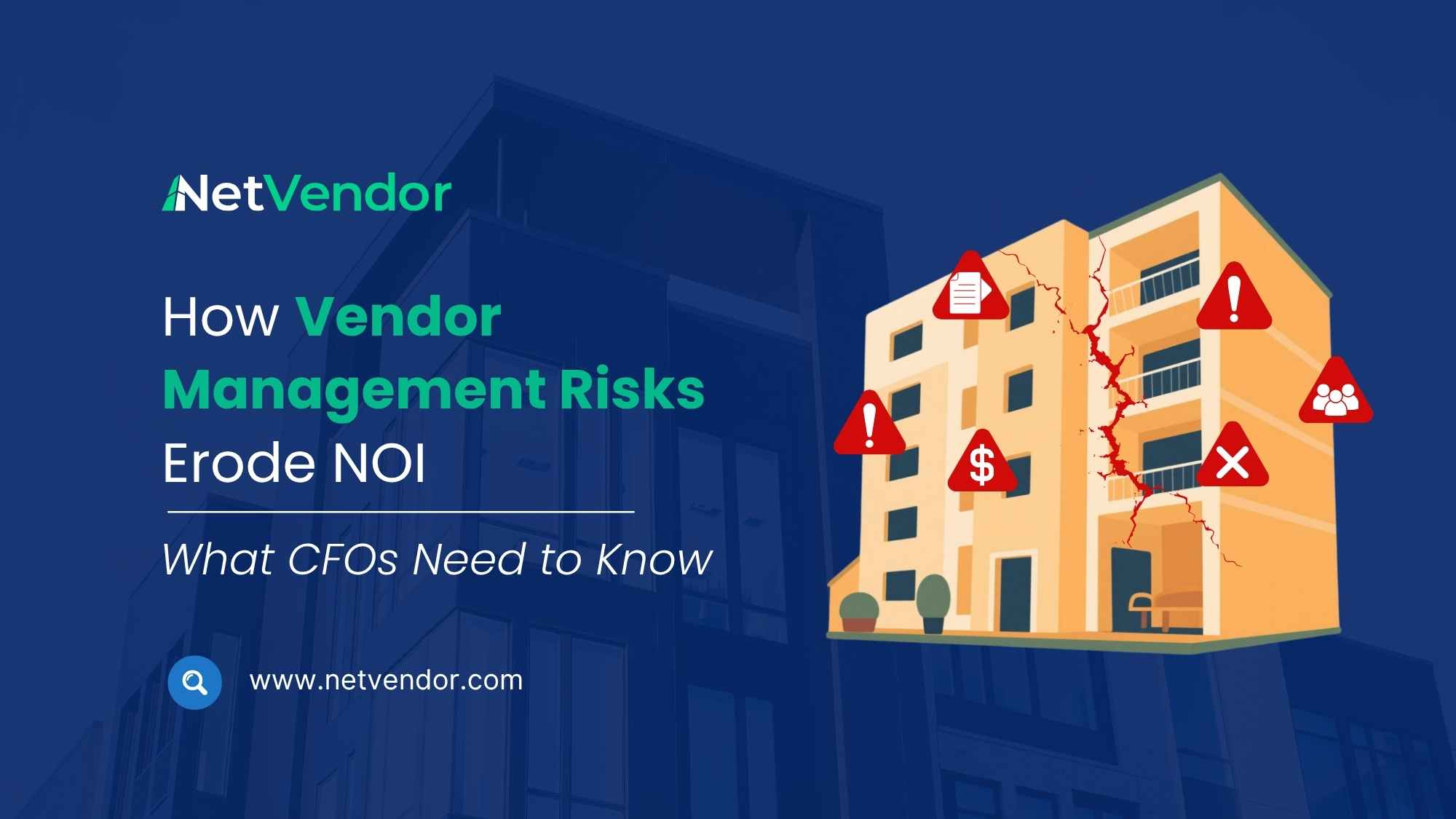
Margins in property management are increasingly sensitive to operational variability. For CFOs, protecting NOI requires controlling risks that originate outside traditional financial systems.
By the time the problem shows up in your financials, NOI has already taken the hit. For CFOs tasked with protecting margins, vendor management isn’t just an operational detail. It’s a financial safeguard.
Vendor risk often goes undetected until it impacts NOI. Assess where lifecycle control gaps may be exposing your portfolio by taking the CFO Vendor Compliance Maturity Assessment.

What Is Vendor Management Risk in Real Estate?
Vendor management risk is the portfolio-level financial exposure created by third-party vendors when their onboarding, compliance, insurance coverage, and work execution are not continuously controlled.
This risk does not originate from a single failure. It accumulates over the vendor lifecycle when compliance is not continuously enforced, reducing NOI through cost variability, liability exposure, and operational inefficiency.
What Is Compliance-Led Vendor Management?
Compliance-Led Vendor Management is vendor management where compliance status is the control point, not a downstream check. Vendor qualification and insurance are verified before a vendor is approved, and every governed action that follows is gated by real-time compliance status at the point of action, not reconciled after the fact.
Vendor lifecycle control is the mechanism behind Compliance-Led Vendor Management: vendor requirements are verified at onboarding, monitored continuously, and enforced at every governed action, including bid award, contract signature and renewal, and payment. It ensures compliance is not just verified at a point in time, but holds for as long as a vendor works in the portfolio.
NetVendor puts this model into practice with unlimited compliance models, configured by owner, property, and vendor type, set once at HQ and enforced automatically, with zero front-line involvement.
Why Compliance-Led Vendor Management Exists
Vendor management failures are not caused by a lack of visibility. They are caused by a lack of lifecycle control. Compliance-Led Vendor Management exists because traditional approaches validate vendors after risk has already entered the portfolio. By verifying qualification and insurance at onboarding and enforcing them at every governed action that follows, this model shifts vendor risk from a reactive issue to a controlled input. For CFOs, this distinction determines whether NOI erosion is detected after impact or contained before it reaches the P&L.
Vendor Management Risks That Erode NOI
Vendor management risks emerge at specific points in the vendor lifecycle and compound when control is not enforced across onboarding, compliance, and execution.
Here’s how common vendor management risks can quietly erode NOI and where CFOs should focus their attention:
Vendor activity is one of the largest controllable risk variables on a property. FM Global property-loss data shows outside contractors account for more than one-third of fire-related property loss and more than half of total loss cost. The compliance gap that creates that exposure is well documented: according to USI Insurance Services, 75% of third parties do not meet contractual insurance requirements, and 10% fall out of compliance without notifying the hiring company.
Why Vendor Risk Remains Invisible in Financial Reporting
Vendor risk rarely appears as a discrete financial line item. Instead, it is distributed across maintenance overruns, legal exposure, delays, and rework, fragmented in ways that make it difficult to isolate but highly impactful at portfolio scale.
How Vendor Risk Aggregates Across a Portfolio
Vendor risk is not isolated to a single property or vendor relationship. It compounds across properties, vendors, and time. A single compliance gap repeated across dozens of vendors creates compounding exposure. Without lifecycle control set once at HQ and enforced across every property, organizations cannot measure total vendor risk because it is distributed across systems, teams, and workflows. This aggregation is what makes vendor risk materially impactful to NOI at scale. NSA Storage (now part of Public Storage) closed that gap by replacing manual vendor tracking with one system, and now manages 2,000+ vendors with 1,100+ properties audit ready.
The Hidden Cost of Compliance Failures
Compliance failures rarely show up as one-time expenses. The financial cost accumulates through repeated project delays, additional legal review, rework cycles, and extended vendor downtime. These costs don't appear on a single line; they compound across properties and time, making them easy to overlook and difficult to reverse once systemic.
These failures are not exceptions. They are the predictable outcome of vendor management systems that lack lifecycle enforcement.

What Lifecycle Control Requires at Scale
Visibility without enforcement allows risk to persist. Most organizations can see vendor compliance gaps. Few can stop non-compliant vendors from winning bids, signing contracts, or getting paid.
Controlling vendor risk requires enforcement at every stage of the vendor lifecycle, not periodic validation. Without enforcement, risk enters during onboarding, compounds during execution, and remains undetected until it impacts NOI.
Where Vendor Risk Enters Without Lifecycle Control
Vendor risk is introduced at specific control failures:
- During onboarding when vendors are approved without full credential validation
- Between compliance checks when insurance expires unnoticed
- At bid award, contract signature or renewal, or invoice approval when compliance status isn’t rechecked before money moves
- Across properties where standards are inconsistently enforced
These gaps are not isolated. At portfolio scale, they repeat across vendors and properties, creating systemic financial exposure. NetVendor’s vendor credentialing verifies policy endorsements, not just certificates, and sends automated expiry notifications, so coverage gaps surface before they reach a bid award or a payment.
How Continuous Compliance Enforcement Stabilizes NOI
Vendor risk cannot be eliminated, but it can be contained. Enforcement is the mechanism that does it.
Organizations that verify compliance at onboarding, monitor it continuously, and enforce it at bid award, contract signature and renewal, and payment reduce the costs that erode NOI.
Vendor onboarding speed is a direct risk control lever. The faster vendors are brought into compliance, the shorter the window where unverified vendors can introduce financial exposure.
Reducing vendor onboarding time without adding risk requires lifecycle enforcement, not process acceleration alone.
Slow onboarding is not an operational delay. It is a period of uncontrolled vendor risk. NetVendor’s Intelligent Processing Center uses AI to read, classify, and route COIs with approve or reject recommendations for expert review, shortening that window without removing human judgment.
How Enforcement Reduces Financial Volatility
Financial exposure decreases when compliance is enforced consistently across the vendor lifecycle. For CFOs, this reduces cost variability and improves forecasting accuracy.
Without one compliance standard enforced across every property, CFOs cannot accurately measure how compliance impacts financial performance, including how to measure the ROI of vendor compliance software across the portfolio.
Financial volatility is a direct result of inconsistent enforcement.
What Effective Lifecycle Enforcement Requires
Enforcement changes the timing of risk. Instead of reacting to compliance failures, organizations prevent them from entering the portfolio.
Effective systems must enforce standards before and during vendor activity:
- Prevent non-compliant vendors from onboarding
- Enforce insurance and credential requirements continuously, not at renewal intervals
- Standardize vendor qualification across all properties and teams
- Block non-compliant vendors from bid awards, contract signature and renewal, and payment
- Surface risk before money moves, not after costs are incurred
At scale, vendor risk is not a visibility problem. It is a control failure that allows preventable exposure to accumulate across the portfolio.

Vendor Compliance vs Vendor Management: Why the Distinction Impacts NOI
Vendor compliance validates documentation. Vendor management controls vendor behavior across the lifecycle.
Vendor Compliance is:
- Document validation
- Point-in-time checks
- Reactive risk detection
Vendor Management is:
- Lifecycle control
- Continuous enforcement
- Preventive risk containment
Compliance alone cannot protect NOI because it does not control when or how vendors enter the portfolio.
Financial exposure is created before compliance systems detect it.
The distinction between vendor management vs vendor compliance software becomes critical at scale. Vendor compliance software focuses on document collection and validation, while vendor management systems enforce standards across the full vendor lifecycle.
Without lifecycle control, compliance software cannot prevent risk from entering the portfolio. It can only identify issues after exposure has already been created.
Vendor management, when structured as a controlled lifecycle, ensures that vendors are qualified and verified before approval, monitored continuously, and held to the standard at every bid award, contract, and payment. This lifecycle enforcement prevents operational and financial risks from compounding across the portfolio.
For CFOs, this distinction is the difference between reacting to NOI erosion after it shows up in the financials and containing it before it reaches the financials.
Vendor management is not a software distinction. It is a financial control decision that determines whether risk is prevented or absorbed.

How Compliance Risk Reduction Improves Financial Performance
Compliance risk reduction is not just regulatory protection. It is a financial control mechanism that reduces cost variability, limits liability exposure, and stabilizes NOI.
Reduces Cost Variability Through Enforcement
When vendor compliance is continuously enforced rather than periodically checked, cost variability decreases. Unplanned expenses from insurance lapses, rework, and liability events can be made predictable or preventable. For CFOs, that predictability translates directly into forecasting accuracy.
The labor cost is measurable too. After replacing manual compliance tracking, Horizon Realty Advisors, which manages 600+ vendors across a multifamily and student housing portfolio, saves $30K+ a year in labor and 30 hours a week of staff time.
Aligns Finance and Operations Around Risk Control
Vendor risk does not originate in the finance department, but its consequences land there. CFOs who establish shared accountability between finance, operations, and procurement create the cross-functional visibility needed to catch lifecycle gaps before they become financial events.
Enforces Lifecycle Control Across Vendor Activity
A single governed lifecycle ensures that every vendor interaction, from initial credentialing through final payment, is tracked, verified, and held to a consistent standard. Without that continuity, compliance at one stage does not protect against failure at another.
When compliance is enforced across the vendor lifecycle, CFOs gain:
- Stronger forecasting accuracy
- Reduced liability exposure
- Greater vendor reliability
- Higher NOI stability
Compliance does not improve financial performance on its own. Enforcement across the vendor lifecycle does.
Vendor risk rarely appears as a single financial line item, but its financial impact compounds across the portfolio. Identify where these risks may be eroding your NOI with the CFO Vendor Compliance Maturity Assessment.

What Systems Must Deliver to Enforce Lifecycle Control
Systems must validate vendor compliance continuously and enforce it at every governed action: bid award, contract signature and renewal, and payment.
NetVendor closes these gaps where commitments and payments are made. Compliance is configured once at HQ by owner, property, and vendor type, then enforced automatically: vendors are not approved until they meet the standard, and non-compliant vendors are blocked from bid awards, contract signature and renewal, and payment.
Enforcement at Bid Award, Contract Signature and Renewal, and Payment
Enforcement follows the vendor from credentialing through project bidding, contract signature and renewal, and payment, all governed by the same compliance model. When a vendor’s coverage lapses mid-contract, NetVendor contacts the vendor’s insurance agent directly for updated documents; until coverage is restored, the vendor is ineligible for new awards and renewals, and its invoices stop at the AP stage.
Berger Communities, which manages 60 communities, reports a 99% risk reduction with payment enforcement in place, along with streamlined onboarding for new properties.
PMS Integrations That Extend Compliance Into AP and PO
NetVendor integrates with Yardi, RealPage, AppFolio, Entrata, MRI, ResMan, and Rent Manager, supports concurrent multi-PMS environments, and offers more multifamily PMS integrations than any platform. One compliance standard applies across every connected system, so noncompliant vendors are stopped at the PO and invoice stage, not after the work is done.
A 275K+ Vendor Ecosystem With 100K+ Already Credentialed
NetVendor’s 275K+ vendor ecosystem, with 100K+ already credentialed, reduces reliance on unverified providers and improves consistency across the portfolio. AI-powered credentialing, human-verified, delivers faster vendor approvals than any platform in the market, which shortens the window where an unverified vendor can introduce financial exposure.
Vendor risk reduction at scale requires systems that enforce compliance, surface risk in real time, and maintain visibility across the full vendor lifecycle.

How CFOs Begin Reducing Vendor Risk Exposure
Protecting NOI requires proactive steps. CFOs don’t have to solve vendor risk overnight, but a structured approach can steadily reduce exposure.
- Identify where vendor risk enters the lifecycle
- Evaluate visibility across vendor compliance and insurance status
- Assess how risk is currently tracked across properties
- Determine whether vendor management is centralized or fragmented
Fragmented tracking across properties is often what makes the ROI of vendor compliance software hard to measure at the portfolio level.
Centralized systems give CFOs the visibility needed to turn vendor management into a measurable financial control. By automating compliance and surfacing risks in real time, finance leaders can reduce exposure, stabilize margins, and improve forecasting accuracy. Benchmarking vendor compliance KPIs reveals where performance gaps exist and how they impact portfolio-level risk and NOI. That benchmark doesn't have to be a one-time exercise. For NetVendor customers, the same visibility runs on a recurring cadence: a NetVendor Health Check walks through compliance percentage, compliance trend, active vendor count, and integration status with your Customer Relationship Manager, giving finance leaders a current, reportable view of how the program is performing.
FAQs About Vendor Risk and NOI
What are vendor management risks in property finance?
Vendor management risks are portfolio-level financial exposures created when vendors are not continuously controlled across onboarding, compliance, and insurance validation. These risks build up over the vendor lifecycle rather than appearing as single events. Common exposure points include insurance lapses, credential gaps, service inconsistency, and compliance failures, which erode NOI through cost variability, liability transfer, and operational disruption.
How does vendor risk affect NOI?
Vendor risk reduces NOI by introducing unplanned costs and liability exposure that originate outside financial systems. Because these costs spread across maintenance overruns, legal review, delays, and rework, they rarely appear as a single line item. At portfolio scale, dozens of lifecycle gaps can compress margins before the source is identifiable.
Why is vendor risk often underestimated in property management?
Vendor risk is underestimated because it stays structurally invisible in financial reporting. Instead of a labeled line item, it appears as elevated maintenance costs, unexpected legal expenses, and margin compression with no clear cause. Spread across multiple properties, vendors, and systems at once, portfolio-level exposure often exceeds what any single incident would suggest.
What is the best way for CFOs to reduce compliance risks?
The most effective approach is enforcing lifecycle control instead of relying on periodic compliance checks. This means preventing non-compliant vendors from onboarding, maintaining continuous insurance and credential validation, and standardizing qualification across all properties. Setting standards once at HQ and enforcing them automatically, rather than leaving compliance to individual property teams, converts vendor management into a measurable financial control.
Why should CFOs care about compliance risk reduction?
Compliance risk reduction directly affects NOI stability. Uncontrolled vendor lifecycle gaps introduce cost variability that weakens forecasting accuracy and leaves margins more exposed. For CFOs, enforcing vendor compliance is not a regulatory checkbox; it is a margin protection strategy. Treating it as lifecycle control delivers measurable gains in cost predictability, liability containment, and operational consistency.
How do vendor management systems support compliance risk reduction?
Vendor management systems reduce compliance risk by enforcing qualification and insurance requirements before vendors are approved, then maintaining oversight throughout the lifecycle. NetVendor, for example, blocks non-compliant vendors from bid awards, contract signature and renewal, and payment at the PO and invoice stage. At portfolio scale, this enforcement removes the manual coordination that lets lifecycle gaps persist undetected.
Take the Next Step Toward Vendor Confidence
Every CFO is responsible for protecting NOI, but most financial exposure originates outside financial systems. Vendor risk enters the portfolio through lifecycle gaps that compliance alone cannot prevent. Compliance-Led Vendor Management transforms vendor oversight into a financial control system by enforcing standards before risk materializes.
NetVendor verifies vendors at onboarding, monitors coverage continuously, and enforces compliance at bid award, contract signature and renewal, and payment, so vendor risk is contained before it reaches NOI.
Organizations that fail to implement lifecycle control will continue to absorb preventable NOI erosion. Those that do will gain stability, predictability, and measurable risk reduction across the portfolio. Vendor risk is one of the few financial exposures that can be systematically contained before it reaches the balance sheet.
Identify where vendor risk is entering your portfolio and how lifecycle control gaps may be impacting NOI. Take the CFO Vendor Compliance Maturity Assessment to evaluate your current state and uncover opportunities to reduce financial exposure.
Download the State of Vendor Management report
Download our report for a broader view of how compliance-driven vendor management is evolving across portfolios.

.png)
Vannessa Rhoades is Content Marketing Manager at NetVendor, where she leads content strategy on vendor management, compliance, and risk for property management operators. She brings 25+ years of experience translating complex, technical subjects into clear, decision-useful guidance for the people who run real estate portfolios.