How To Benchmark Your Vendor Compliance KPIs: Rank Your PMC
Your compliance data tells a story. The question is whether that story reflects a high-performing, audit-ready portfolio or one vulnerable to unseen risk. Most property management companies (PMCs) track compliance. Few understand what those numbers reveal about vendor lifecycle risk across their portfolio. Vendor risk becomes harder to detect as portfolio complexity increases across properties, vendors, and systems.
In property management, compliance isn’t just a checklist. It’s a reflection of operational control, financial discipline, and vendor trust. Yet, many PMCs still don’t know how they truly stack up. That’s where vendor compliance benchmarking comes in.
If you’ve ever wondered how your organization compares to industry leaders (or how your compliance KPIs translate to real financial impact), this is your starting point.
Identify where vendor risk is already building across your portfolio. Download the free Compliance KPI Scorecard to benchmark your current compliance performance against leading PMCs.

What Is Vendor Compliance Benchmarking?
Vendor compliance benchmarking is the process of measuring vendor lifecycle performance across compliance status, approval speed, and engagement to quantify portfolio risk exposure and audit readiness. It transforms compliance data into a forward-looking indicator of operational control and financial vulnerability. NetVendor gives PMCs this view by keeping each vendor’s credentials, insurance verification, and compliance status in one record across every property.
Why Vendor Compliance Benchmarking Matters for Property Management Companies (PMCs)
Benchmarking gives property management executives a measurable way to assess their organization's risk exposure and operational efficiency. More importantly, benchmarking reveals where vendor lifecycle breakdowns are already introducing hidden financial and insurance risk into the portfolio.
In simple terms, benchmarking your compliance KPIs helps answer four key questions:
- How compliant is your vendor network, really?
- How quickly can you identify and address compliance gaps?
- How does your audit readiness compare to best-in-class PMCs?
- Where is vendor risk accumulating across properties, regions, or vendor categories?
Non-compliance compounds into portfolio-level exposure when vendor lifecycle gaps go unmeasured and unmanaged. This is especially pronounced in multifamily and commercial real estate portfolios, where vendor volume is high, insurance requirements vary by ownership group, and a single compliance gap can propagate across dozens of properties simultaneously. Each unverified vendor, expired insurance certificate, or missed renewal introduces potential liability. Over time, those gaps translate into claims risk, administrative overhead, and brand damage.
When compliance data is centralized, measurable, and benchmarked, it stops being a back-office task and starts becoming a strategic advantage.
Vendor Lifecycle KPIs That Reveal Hidden Portfolio Risk
To know where your PMC stands, start by measuring the metrics that define compliance excellence. Together, these KPIs reveal how vendor risk aggregates across the portfolio, rather than remaining isolated to individual vendors or properties.
1. Percentage of Vendors Fully Compliant and Audit-Ready
The faster you maintain full compliance across your vendor base, the lower your exposure and the stronger your audit performance.
This KPI is the foundation. It represents the share of your vendor network that meets all insurance, licensing, and documentation requirements.
High-performing PMCs aim for near-real-time visibility into this number. When a certificate is missing or nearing expiration, NetVendor sends automated expiry notifications and contacts the vendor’s insurance agent directly, so the compliance rate does not depend on staff chasing documents. A declining compliance rate is not just a metric shift. It signals expanding insurance lapse exposure across the vendor network.
2. Average Time to Vendor Approval
Reducing approval time directly increases operational agility and helps teams meet service-level expectations across large portfolios.
Speed to compliance is a key performance indicator often overlooked. The longer it takes to approve a vendor, the more it delays project start dates and drives up operating costs.
NetVendor’s Intelligent Processing Center uses AI to read, classify, and route certificates, then recommends approve or reject decisions for expert review, which shortens time to compliance without removing human judgment. Extended approval timelines increase the likelihood that work will be performed by unverified vendors, introducing immediate liability risk.
3. Vendor Adoption and Engagement Rate
When vendors fully adopt your compliance system, you gain trustworthy data and reduce time spent on manual follow-ups.
A compliance process is only as strong as the vendors who participate in it. PMCs that simplify enrollment achieve higher adoption rates, which in turn drive more accurate compliance data.
NetVendor’s network includes 100K+ credentialed vendors, so many vendors a PMC invites already have credentials on file, and bilingual support in English and Spanish helps the rest complete enrollment. Low vendor adoption weakens data integrity, making it impossible to accurately assess portfolio-wide compliance risk.
Vendor Compliance Tracking vs Vendor Lifecycle Control
Tracking compliance shows where issues exist. Controlling the vendor lifecycle prevents those issues from entering the portfolio in the first place.
Benchmarking identifies gaps in compliance performance, but it does not eliminate the underlying risk. Without lifecycle control, non-compliant vendors, expired insurance, and approval delays continue to accumulate across the portfolio.
This is the difference between compliance reporting and Compliance-Led Vendor Management, the approach NetVendor built its platform on. One measures exposure. The other controls it.
Vendor lifecycle control is the mechanism behind Compliance-Led Vendor Management: vendor requirements are verified at onboarding, monitored continuously, and enforced at every governed action, including bid award, contract signature and renewal, and payment. It ensures compliance is not just verified at a point in time, but holds for as long as a vendor works in the portfolio.

Measuring the Financial Impact of Compliance Audit Metrics
Compliance KPIs are not operational metrics. They are leading indicators of financial exposure across the vendor lifecycle, including how vendor management risks erode NOI when compliance gaps go unaddressed. Compliance performance directly affects financial outcomes.
Strong compliance performance is a measurable driver of financial stability and risk reduction. When compliance gaps go unmeasured, vendor risk aggregates across properties, vendors, and time rather than remaining isolated, which increases the probability of claims, delays, and cost overruns.
Real-World Examples of PMCs Improving Performance Through Compliance Automation
The financial impact is measurable. NSA Storage (now part of Public Storage) moved compliance for 2,000+ vendors out of spreadsheets and email and into one system, and now keeps 1,100+ properties audit ready. On the multifamily side, Horizon Realty Advisors brought compliance for 600+ vendors across its multifamily and student housing portfolio into NetVendor, saving 30 hours a week and $30K+ in annual labor.
Measurable compliance performance consistently translates into:
- Reduced insurance claim exposure
- Faster project timelines
- Lower administrative costs
- Improved vendor relationships
Pinpoint where compliance gaps are creating exposure. Ready to see where your PMC stands? Get NetVendor’s Compliance KPI Scorecard to benchmark your compliance metrics today.
How To Benchmark Your PMC’s Compliance Performance Against Industry Standards
To benchmark your PMC’s compliance health, start with visibility.
1. Build Your Baseline
Gather compliance data from your PMS or existing tracking system. Measure the three core KPIs: compliance rate, approval time, and adoption rate.
2. Compare Portfolio Trends
Identify regional or property-level gaps. Look for trends that indicate recurring risk exposure or slow processing.
3. Set Targets Based on Top-Quartile Benchmarks
Berger Communities moved from manual, binder-based tracking to automated compliance across 60 communities, achieving a 99% risk reduction and streamlined onboarding for new properties. Use outcomes like these to set targets for compliance rate and onboarding speed rather than settling for the portfolio average.
NetVendor provides portfolio-wide compliance reporting, so executives can track compliance status at both the property and corporate levels. Over time, you’ll see patterns in vendor performance and understand which categories need attention. Benchmarking only becomes valuable when it leads to intervention. Without lifecycle control, KPI improvements are temporary, and risk persists.
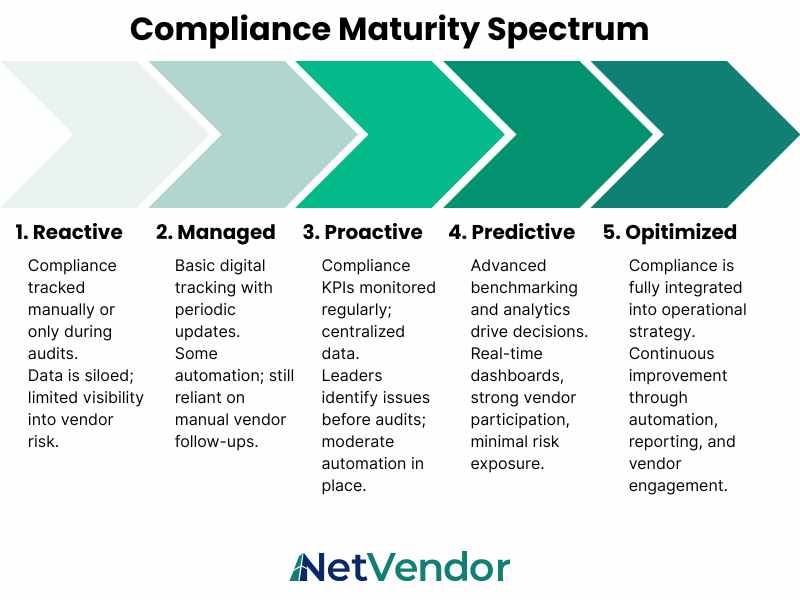
Before assessing your organization’s compliance benchmarks, it helps to understand the broader compliance maturity journey. The Compliance Maturity Spectrum illustrates how PMCs typically progress: from reactive, manual processes to fully optimized, automated compliance operations. Use this visual to pinpoint where your organization currently stands before diving into the qualitative benchmarking framework.
Qualitative Compliance Benchmark Framework Table
This framework translates compliance performance into measurable portfolio risk, allowing executives to identify where vendor lifecycle breakdowns are creating exposure.
Each stage of maturity corresponds to a different level of portfolio risk exposure.
Most PMCs operate across multiple maturity levels at once, which is how vendor risk aggregates across the portfolio.
Turning Compliance Data Into Actionable Strategy
The goal is not better reporting. The goal is to control vendor lifecycle risk before it impacts operations or financial performance.
The PMCs that win operationally are the ones that use compliance data not just to track performance, but to shape it. Once you have your benchmarks, the next step is transforming compliance insights into strategy.
Executives can use KPI trends to:
- Strengthen vendor network reliability through data-backed ratings
- Identify high-risk vendors before issues arise
- Allocate resources toward underperforming portfolios
- Reinforce ownership confidence with transparent reporting
- Quantify vendor risk aggregation across the portfolio
Benchmark data becomes actionable when it governs who wins and signs the work. In the Bidding and Contracts lifecycle in NetVendor, compliant vendors compete for work, every award can move into a governed contract, and credential status is checked at bid award, contract signature, and renewal, with one audit trail from bid invite to signed contract.

What to Look for in Vendor Compliance Benchmarking Software
Benchmarking is only as reliable as the data behind it. Software that supports it should keep compliance data in one place, verify what vendors submit, and carry compliance status into the actions where risk becomes cost. NetVendor is vendor management built on compliance, not compliance added to vendor management.
Look for:
- Portfolio-wide visibility. Compliance status by vendor, property, and region should sit in one view. NetVendor provides portfolio-wide compliance reporting across every property.
- Verification depth. A certificate alone can hide coverage gaps. NetVendor verifies policy endorsements, not just certificates, and contacts vendors’ insurance agents directly.
- Enforcement at governed actions. Compliance status should control the actions where risk turns into cost. NetVendor enforces compliance at bid award, contract signature and renewal, and payment at the PO and invoice stage.
- PMS integration depth. Status should reach the systems that pay vendors. NetVendor has more PMS integrations than any platform, including Yardi, RealPage, AppFolio, Entrata, MRI, ResMan, and Rent Manager, and supports concurrent multi-PMS environments.
- Audit-ready records. Vendor files should be complete and current without a scramble before reviews. NetVendor keeps audit-ready documentation for ownership and lender reporting.
Requirements also differ by owner and asset. In NetVendor, compliance requirements are configured by owner, property, and vendor type, set once at HQ and enforced automatically, with no front-line configuration required. That keeps benchmarks comparable, because each property is measured against the standard its owner actually requires.
FAQ: Benchmarking and Improving Vendor Compliance KPIs
What is vendor compliance benchmarking?
Vendor compliance benchmarking is the process of measuring your PMC's compliance KPIs (vendor approval time, compliance rate, and audit readiness) against industry standards to quantify risk exposure and identify gaps in the lifecycle. For multifamily and commercial portfolios, benchmarking reveals where vendor risk is accumulating across properties before it surfaces as claims, delays, or audit failures.
Which compliance KPIs should I track?
The three most important KPIs are compliance rate (percentage of vendors fully insured and credentialed), vendor approval time (how quickly new vendors move from onboarding to active status), and vendor adoption rate (how consistently vendors participate in your compliance system). Together, they reveal whether your compliance program is controlling vendor lifecycle risk or simply documenting it.
How can compliance metrics improve financial outcomes?
Compliance metrics identify vendor lifecycle gaps before they compound into financial exposure: denied insurance claims, regulatory fines, project delays, and administrative overhead. PMCs that track compliance KPIs consistently can quantify avoided costs, measure ROI on compliance investment, and make data-backed decisions about vendor network risk rather than relying on reactive incident reporting after exposure has already occurred.
What happens if vendor compliance is not benchmarked?
Without benchmarking, vendor lifecycle gaps remain invisible; non-compliant vendors, expired insurance certificates, and slow approval cycles accumulate risk across the portfolio without measurable detection. At multifamily and commercial scale, this creates systemic exposure that only surfaces during audits, ownership reviews, or insurance claims, by which point the financial and operational damage is already done.
How does NetVendor help with compliance benchmarking?
NetVendor keeps vendor compliance in one record across onboarding, credentialing, insurance verification, and renewal, with portfolio-wide reporting on compliance status by property. Its integrations with Yardi, RealPage, AppFolio, Entrata, MRI, ResMan, and Rent Manager carry that status into AP, so noncompliant vendors are stopped at the PO and invoice stage.
Improve Your Vendor Compliance KPIs with NetVendor
Compliance success isn’t just about passing audits. It’s about knowing your numbers, reducing your risk, and giving ownership teams confidence that every vendor in the portfolio is verified against their requirements. NetVendor verifies vendor requirements at onboarding, monitors them continuously, and enforces them at bid award, contract signature and renewal, and payment.
Get NetVendor’s Compliance KPI Scorecard to benchmark your vendor lifecycle performance and identify where risk is already impacting your portfolio.
Benchmarking is not about tracking performance. It is about identifying and controlling vendor risk before it becomes financial exposure, and keeping compliance in force for as long as each vendor works in the portfolio.
Download the State of Vendor Management report
Download our report for a broader view of how compliance-driven vendor management is evolving across portfolios.

.png)
Vannessa Rhoades is Content Marketing Manager at NetVendor, where she leads content strategy on vendor management, compliance, and risk for property management operators. She brings 25+ years of experience translating complex, technical subjects into clear, decision-useful guidance for the people who run real estate portfolios.