What Is Vendor Bidding Software in Property Management?
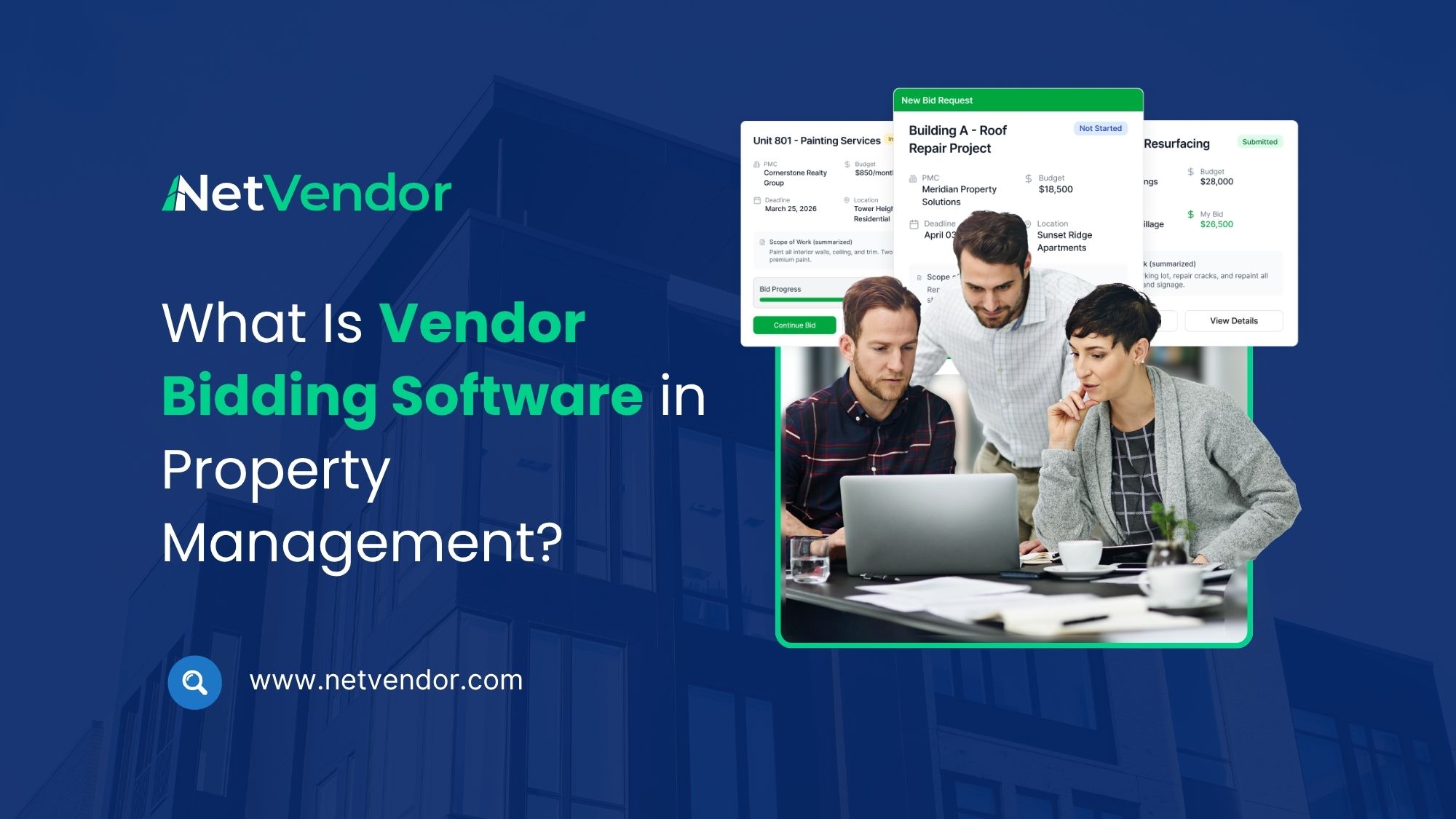
Vendor bidding software manages the full lifecycle of soliciting, comparing, and awarding vendor bids. It also enforces compliance requirements (such as insurance and licensing) at the point of award, so price and risk are evaluated together rather than separately. A single uncompetitive bid rarely breaks a budget. A hundred of them, repeated across a portfolio every year, quietly do. At NetVendor, closing the cost gap and the compliance gap in a single system, not two separate ones, is the foundation of a Compliance-Led Vendor Management approach.
Curious how much this gap is actually costing your portfolio? Download The Portfolio Bidding Strategy Whitepaper for a closer look at what a defensible, compliant bidding process looks like at scale.
What Is Vendor Bidding Software?
Vendor bidding software is a platform that manages the full lifecycle of soliciting, comparing, and awarding vendor bids, from RFP creation through vendor selection. It also enforces compliance requirements like insurance and licensing at the point of award. That first step, soliciting bids, is sometimes called vendor invitation management: sending the same request to every qualified vendor at the same time, instead of working through a list one email at a time. Instead of bids living in inboxes and spreadsheets, they live in one system that every stakeholder can see and act on.

What Is a Vendor Bid?
A vendor bid is a vendor's formal response to a request to bid (RFB) or invitation to bid (ITB): what they'll charge, what's included, and what compliance documentation (insurance, licensing, W-9s) they can provide. In property management, bids typically cover recurring service contracts (landscaping, janitorial, pest control) and capital or turn-related projects. Most PMCs solicit a minimum of three to five bids per scope of work, an industry standard for keeping pricing competitive and decisions defensible, so a PMC can compare scope of work, price, timeline, and compliance risk side by side.

Vendor Bidding Software vs. General Procurement Software
Not every procurement tool is built for the compliance realities of property management. The distinction matters when evaluating what to buy.
A generic procurement tool can help a company track a purchase order. It typically can't stop a bid from being awarded to a vendor whose insurance lapsed last month because that's a property management-specific compliance problem, not a general purchasing one. That's the gap Compliance-Led Vendor Management is built to close: treating bid award and compliance enforcement as one decision, not two separate systems.
Why Vendor Bidding Software Matters at Portfolio Scale
For a single-property owner, an uncompetitive bid is an inconvenience. For a portfolio operator managing dozens or hundreds of properties, it's a systemic cost problem. Structured, competitive bidding resets pricing and increases transparency, surfacing recurring savings with every contract cycle. The National Apartment Association calls vendor spending property management's "hidden quarter": for portfolios of 500 units or more, vendor spend accounts for over 25 percent of total operating expense, a lever most operators aren't actively managing even though it sits in plain sight.
The math is straightforward. That quarter of operating expense is one of the few levers an operator can adjust directly, without raising rents or deploying capital. Left uncompetitive, it isn't a rounding error. It's the difference between a vendor program that funds itself and one that quietly drags on NOI.
Cost isn't the only thing riding on how bidding is managed, either. Berger Communities, a 60-community multifamily and commercial operator, saw compliance risk drop 99% after moving from manual tracking to an automated bidding and compliance system, recovering hundreds of staff hours in the process.
This is also why bidding can't be treated as an isolated task. It's part of a larger shift: as procurement evolves with technology, portfolios that upgrade only the bidding step while leaving the rest manual tend to move the bottleneck downstream.
Part of that shift is AI. AI-assisted vendor matching, which surfaces qualified, currently compliant vendors by trade and location before an RFP even goes out, is starting to replace the manual work of building a bidder list from memory or a shared spreadsheet. The outcome is the point: faster bid cycles with a pool that's already vetted, not AI for its own sake.

What Happens When Vendor Bidding Is Managed Manually?
Manual bidding doesn't just cost money. It creates blind spots.
- Bids get compared unevenly. Without a standard format, one vendor's "$4,000 for landscaping" and another's "$4,000 plus materials" look identical until someone reads the fine print, if anyone does.
- Compliance gets checked once, then forgotten. A vendor's certificate of insurance might be current the day a bid is submitted and expired by the time the contract renews. Nothing in a spreadsheet catches that.
- Communication becomes the bottleneck. Chasing vendors for updated pricing, clarifications, or missing documents by phone and email eats hours every week, and status lives in someone's inbox instead of a shared system.
- Awards happen on incomplete information. When bid data is scattered across formats and follow-up threads, the easiest vendor to reach often wins, not the best-priced or best-qualified one.
None of this ends in a clear, defensible decision. It ends in whichever bid was easiest to piece together, which is a different thing, and one that's hard to justify later if an owner or auditor asks why a vendor was chosen.
That last point also compounds into a real relationship cost. Industry survey data puts the average property management company's vendor attrition at over four vendor relationships lost per year to payment delays, communication breakdowns, and scheduling conflicts, all failure points a manual bidding process makes worse, not better.
Ready to move past ad hoc bidding? Download The Portfolio Bidding Strategy Whitepaper to see how leading PMCs structure bidding and compliance as one process instead of two.

How to Streamline Vendor Communication for Bid Updates
Most of the administrative drag in bidding isn't the bidding itself; it's the back-and-forth around it. A few practices consistently cut that overhead:
- Centralize bid status in one system that vendors and staff both see. No more "did you get my email" follow-ups.
- Automate status notifications when a bid is submitted, updated, or awarded, so nobody has to manually chase updates.
- Standardize the RFP format so every vendor responds to the same scope, on the same fields, making comparison instant instead of a translation exercise.
- Route approvals automatically based on bid amount or property, so awards don't stall waiting on someone to notice an email.
- Surface compliance status inline with pricing, so the person comparing bids sees cost and risk in the same view, not in two different systems.

What Makes the Best Procurement Software for Vendor Bid Compliance?
The best procurement software for vendor bid compliance enforces requirements at every stage, not just at onboarding, and gives every stakeholder the same view of price, scope, and compliance status. The specifics to check for:
- Compliance configurability by owner, property, and vendor type. Portfolios with mixed ownership structures require different insurance and licensing requirements to be enforced automatically, not managed as one-size-fits-all.
- Enforcement at the point of award, not just at onboarding. A certificate that was valid when a vendor joined the network can lapse before the next bid cycle. The system should catch that automatically, blocking non-compliant vendors from being awarded a bid or renewed on a contract.
- Concurrent multi-PMS support. Portfolios running Yardi, RealPage, AppFolio, Entrata, MRI, ResMan, or Rent Manager across different ownership groups need a single compliance standard, not a separate process for each system.
- Structured bid leveling. Side-by-side comparison of scope, price, and vendor compliance status, not a stack of PDFs in different formats.
- A vendor network that's already credentialed. The fewer vendors a PMC has to onboard from scratch, the faster bidding gets off the ground.

NetVendor's Compliance-Led Approach to Vendor Bidding
NetVendor treats vendor bidding as a compliance checkpoint, not just a procurement step. Bid approval routing and side-by-side bid leveling are live in the platform today. AI-assisted vendor matching, which surfaces qualified vendors by trade, location, and current compliance status, is already running in a live bidding deployment, shortening the time between opening an RFP and getting it in front of vendors who are actually eligible to win it. Non-compliant vendors are automatically blocked from bid awards and contract renewals, so a lapsed certificate can't slip through when it matters most.
"A competitive bid is only as good as the list it starts from. If you are collecting bids from vendors nobody vetted, you have optimized for price on top of unmanaged risk. In NetVendor, every bid begins from your approved, compliant vendor pool, so the vendor who wins is already cleared to do the work before the award is made." — Tayo Olowu, Product Manager, NetVendor
That enforcement runs concurrently across NetVendor's PMS integrations (Yardi, RealPage, AppFolio, Entrata, MRI, ResMan, and Rent Manager), so a portfolio split across multiple systems still enforces a single compliance standard. It's also backed by a vendor ecosystem of 275,000+ vendors, with more than 100,000 already credentialed, meaning most bidding cycles don't start with an onboarding project.
Berger Communities, a 60-community multifamily and commercial operator, moved off a manually tracked compliance process (literally a binder) to an automated system and saw a 99% reduction in compliance risk, along with hundreds of hours of staff time recovered that used to go toward chasing vendors for paperwork.
Vendor Bidding Software and Procurement Compliance FAQ
Is vendor bidding software the same as procurement software?
No. General procurement software manages purchase orders and spend tracking across any purchase category. Vendor bidding software manages the RFP-to-award workflow specifically for vendors and, in property management, enforces compliance requirements like insurance and licensing at the point of award, not just after a contract is signed.
What's the difference between a vendor bid and a vendor quote?
A quote is typically a single vendor's price for a defined job. A bid usually implies competition: multiple vendors respond to the same scope, allowing a property management company to compare price, scope, and compliance status side by side before awarding the work.
Can vendor bidding software stop a non-compliant vendor from winning a bid?
Yes. Vendor bidding software can block a non-compliant vendor from winning a bid when the platform enforces compliance at the award stage, not just at onboarding. A vendor with an expired certificate of insurance can be automatically blocked from being awarded a bid or renewing a contract. NetVendor applies this check automatically across every bid and renewal.
Does vendor bidding software work across multiple property management systems?
Yes. The strongest platforms support multiple property management systems concurrently. A portfolio running Yardi in one ownership group and AppFolio or Entrata in another needs bidding and compliance enforcement that works across all of them at once, not a separate tool per system.
Building a Bidding Strategy That Scales Across Your Portfolio
Uncompetitive bidding rarely announces itself. It shows up as margin that never quite materializes and compliance gaps nobody catches until an incident forces the question. Compliance-Led Vendor Management treats those two problems, cost and risk, as one process instead of two, configured by owner, property, and vendor type rather than bolted on generically, and bidding is where that approach either pays off or quietly fails.
For a closer look at how to structure a bidding strategy across a growing portfolio, get the Portfolio Bidding Strategy Whitepaper.
Download the State of Vendor Management report
Download our report for a broader view of how compliance-driven vendor management is evolving across portfolios.

.png)
Vannessa Rhoades is Content Marketing Manager at NetVendor, where she leads content strategy on vendor management, compliance, and risk for property management operators. She brings 25+ years of experience translating complex, technical subjects into clear, decision-useful guidance for the people who run real estate portfolios.