Procurement Best Practices That Protect Your PMC's Portfolio
Your regional maintenance director receives three bids for a roof replacement.
One vendor has an expired COI.
Another includes a vague scope.
The third has attractive pricing but no track record with your properties.
Three bids. Zero clarity. High risk.
This is the moment where procurement either shields your operations or amplifies risk across your entire portfolio.
Across multifamily, student housing, commercial, and mixed portfolios, PMCs now recognize a critical shift: procurement best practices must control how vendors enter, move through, and remain compliant within the portfolio lifecycle. They must also strengthen vendor ecosystems and enable portfolio-wide consistency.
Portfolio procurement is no longer optional; it is the backbone of predictable operations.
Today’s leaders are eliminating spreadsheets and disconnected systems. They’re building connected, compliance-first procurement strategies that scale with every property in the portfolio.
Want to see how leading PMCs structure procurement across the full vendor lifecycle? The Portfolio Procurement Strategy Whitepaper breaks down how connected procurement models reduce risk at scale.

What Are Procurement Best Practices in Property Management?
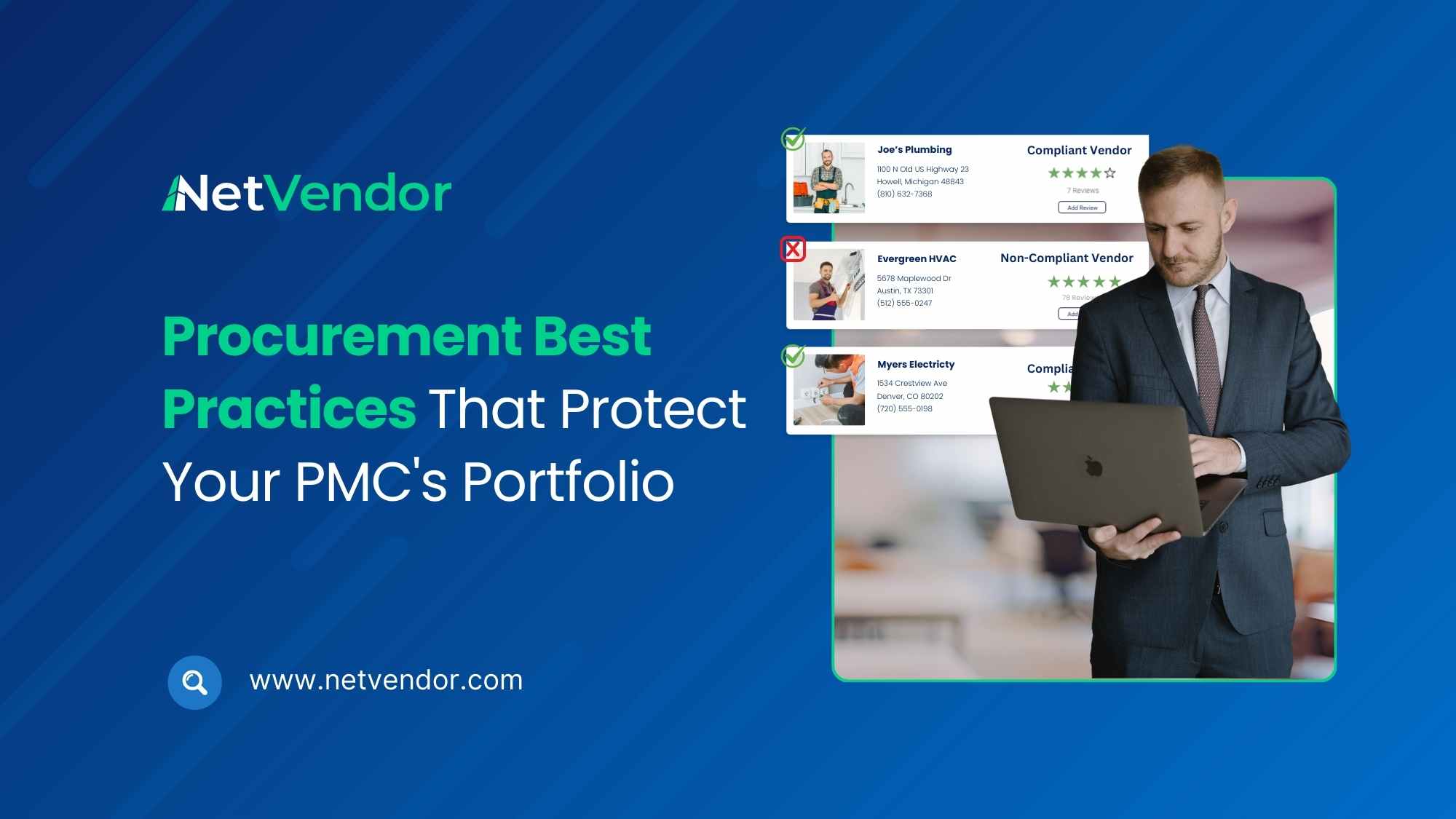
Procurement best practices in property management are standardized, compliance-driven processes that control how vendors are sourced, qualified, selected, and managed across a portfolio. Effective procurement ensures only compliant vendors enter the lifecycle, reducing financial, legal, and operational risk at scale. NetVendor applies this in its bidding workflow, where every bid competes inside a pre-credentialed vendor pool and non-compliant vendors are blocked automatically from bid award.
Why Connected Procurement Reduces Portfolio Risk
Procurement failures rarely begin at bidding. They originate when vendor lifecycle controls are weak before a bid is ever issued.
Modern PMCs must navigate diverse vendor pools, heightened insurance requirements, and multi-PMS environments. With vendors involved in nearly every operational touchpoint, procurement risk reduction must be engineered into the entire vendor lifecycle, not patched reactively during bidding.
Procurement delivers consistent ROI only when it is embedded in broader operational systems rather than managed as a standalone function. In McKinsey & Company's analysis of more than 340,000 transformation initiatives, procurement accounted for over 20% of total transformation value, and companies that hit their procurement savings target were nearly twice as likely to hit their business-wide target. The same research found the average savings pipeline loses about one-third of its projected value in planning and another 20% in execution, value that disciplined, standardized procurement is built to protect.
This shift requires procurement to be governed continuously, not just executed during sourcing events. NetVendor built its platform on Compliance-Led Vendor Management. Vendor lifecycle control is the mechanism behind Compliance-Led Vendor Management: vendor requirements are verified at onboarding, monitored continuously, and enforced at every governed action, including bid award, contract signature and renewal, and payment. It ensures compliance is not just verified at a point in time, but holds for as long as a vendor works in the portfolio.
Procurement is evolving into a technology-driven control system that standardizes vendor selection, compliance, and performance across the entire portfolio.
The Hidden Costs of Outdated Procurement Processes
Procurement failures are rarely one-off mistakes. They reveal structural issues that cause portfolio-level financial exposure:
- Bid cycles that stretch from days to weeks
- Inconsistent scopes that create unnecessary change orders
- Non-compliant vendors introducing liability, claims risk, and owner disputes
- Properties sourcing from unapproved vendor lists
- Lost documentation and unclear approval pathways
- Missed opportunities to rebid or optimize spend
High-performing procurement organizations reduce risk and improve outcomes by standardizing workflows, centralizing vendor risk controls, and consolidating vendor and contract data into a single system. In a Deloitte Global CPO Survey of nearly 350 procurement leaders across more than 40 countries, standardization of processes, systems, and data ranked as the top strategy for managing volatility, and the highest-performing teams, which Deloitte calls Orchestrators of Value, applied it 20% more often than their lower-performing peers. More than a quarter of CPOs named internal complexity, including organizational silos and nonstandard processes, as a top-three issue.
At scale, these failures compound into portfolio risk exposure, including uninsured vendor incidents, contract disputes, delayed capital projects, and loss of owner confidence.

Where Procurement Fits in the Vendor Lifecycle
Procurement is not a standalone function. It operates inside the broader vendor lifecycle, which governs how vendors are sourced, qualified, approved, managed, and evaluated across a portfolio.
Procurement controls how vendors are selected and how work is awarded, but it depends on upstream compliance and downstream performance management to reduce risk.
When procurement operates without lifecycle integration, risk enters before the bid through unverified vendors and after the award through unmanaged compliance, contracts, and performance.
This is why leading PMCs are shifting toward lifecycle-based models, where procurement decisions are enforced through continuous vendor compliance and portfolio-wide controls.
NetVendor connects these stages through one compliance record: when a vendor’s coverage lapses, the same status that governs bid eligibility also blocks contract renewal and payment at the PO and invoice stage.
Procurement Best Practices Every PMC Should Operationalize
These procurement best practices strengthen vendor relationships, reduce liability, and support portfolio procurement at scale.
Standardize Vendor Prequalification to Reduce Risk
High-performing procurement programs begin with vendor verification and compliance-first prequalification.
A unified credentialing model ensures only safe, qualified vendors enter your network:
- W-9 validation
- TIN checks
- Insurance verification
- Credentialing by service type
- Background checks when required
Automated credentialing eliminates manual follow-up and removes guesswork. NetVendor’s Intelligent Processing Center reads each certificate and recommends an approve or reject decision for expert review, and NetVendor verifies policy endorsements, not just certificates, so procurement teams draw from 100K+ credentialed vendors instead of rebuilding lists property by property.
With a unified system, procurement teams avoid revalidating vendors for every new project, thereby reducing procurement risk.
Build a Trusted and Scalable Vendor Network
Relying on property teams to maintain vendor lists creates inconsistency and risk.
A strong portfolio procurement model includes:
- Centralized vendor data
- A dynamic, compliant vendor directory
- Preferred vendor tagging
- Sourcing expansion into vetted external ecosystems
This approach supports every major vertical:
- Multifamily: recurring services + capex readiness
- Student housing: seasonal surge demands
- Commercial: consistent vendor standards across retail, office, industrial, and self-storage portfolios
Horizon Realty Advisors, which manages multifamily and student housing, shows the impact. After moving 600+ vendors off manual, AP-managed tracking, Horizon saves 30 hours per week and $30K+ in annual labor.
Use Portfolio Procurement Workflows That Scale
Standardization ensures every project, regardless of property or region, follows consistent rules.
Your workflows should include:
- Scope of work templates
- Defined approval routing
- Trade-specific insurance requirements
- Required documentation for every bid
This creates transparency and predictability at scale across your portfolio. With NetVendor, compliance requirements are configured by owner, property, and vendor type, set once at HQ and enforced automatically, so every property follows the same rules without front-line setup.

Modern Vendor Bidding Workflows That Reduce Risk
Vendor bidding is the execution layer of procurement, where lifecycle controls determine which vendors are eligible, comparable, and compliant.
Start Every Bid Event With a Compliant Vendor List
This is one of the most reliable drivers of procurement risk reduction. When only compliant vendors receive bid invitations, PMCs eliminate:
- COI delays
- Insurance disputes
- Late onboarding rework
- Owner agreement violations
NetVendor runs bidding inside a pre-credentialed vendor pool, and its AI-powered search surfaces vendors by trade, location, and compliance status, so wider bid lists don’t add compliance risk.
Use Side-by-Side Comparisons for Stronger Decisions
Standardized comparisons improve decision quality:
- Pricing
- Scope clarity
- Project timing
- Compliance status
- Required documentation
This strengthens leadership visibility and owner relationships.

Expand Vendor Access Without Increasing Risk
Procurement performance breaks down when vendor access expands without corresponding compliance controls. Increasing bid volume without verifying vendors introduces risk rather than competition.
Expanding vendor access requires a system that increases sourcing capacity while enforcing compliance controls. NetVendor’s ecosystem of 275K+ vendors, 100K+ already credentialed, lets procurement teams widen bid lists while inviting only vendors that meet their compliance requirements. Sourcing capacity expands without expanding risk because compliance is the entry condition, not a later check.
Expanding vendor networks without increasing risk requires more than sourcing. It depends on how compliance, bidding, and vendor performance are connected across the lifecycle. The Portfolio Procurement Strategy Whitepaper outlines how leading PMCs structure this end-to-end system.
Reducing Procurement Risk Across the Entire Vendor Lifecycle
Procurement is not an event. It is a lifecycle control system governing vendor risk from sourcing through contract expiration. In practice, this means procurement governs vendor qualification, compliance enforcement, bid participation, contract oversight, and ongoing performance across the portfolio.
Procurement does not begin at the RFP and does not end at award.
Connect Compliance, Procurement, and Maintenance
Disconnected systems multiply operational and financial risk.
A connected vendor lifecycle, anchored in compliance, ensures:
- Vendors remain compliant after award
- Maintenance and turn teams draw from the same vetted vendor network
- Capex projects rely on prequalified partners
- Procurement decisions draw from real vendor performance data
This eliminates fragmentation and boosts operational confidence.
Make Contract Management a Core Procurement Function
Contract lapses create financial exposure and owner-agreement violations.
Best practices include:
- Centralized contract storage
- Automated expiration alerts
- Renewal and rebid workflows
- Complete documentation trails
NetVendor keeps every vendor contract tied to a credentialed vendor from eSignature through renewal, with cascading renewal alerts, so nothing renews, expires, or goes unsigned without visibility.
Real-World Validation Across Diverse Portfolios
Across verticals, PMCs are proving the value of connected procurement ecosystems:
- Horizon Realty Advisors (multifamily and student housing) reached a 99% reduction in vendor risk after consolidating vendor management onto a compliant network.
- Berger Communities (multifamily) replaced binder-based compliance tracking across 60 communities, reaching a 99% risk reduction and streamlined onboarding for new properties.
- NSA Storage (now part of Public Storage), a self-storage operator, brought 2,000+ vendors under one compliance system and keeps 1,100+ properties audit ready.
Together, these outcomes demonstrate how standardized vendor management drives reliability at scale.

Technology That Future-Proofs Portfolio Procurement
Technology is now the foundation of modern procurement best practices.
PMS Integration Is Essential for Procurement Accuracy
Multi-PMS portfolios face a heightened risk of data inconsistency.
NetVendor integrates with Yardi, RealPage, AppFolio, Entrata, MRI, ResMan, and Rent Manager, including concurrent multi-PMS environments no single-PMS platform can match. The integration is governance, not just a data feed: when a vendor falls out of compliance, every connected system knows, and noncompliant vendors are stopped at the PO and invoice stage, not after the work is done.
Use Analytics to Strengthen Decisions
Key procurement metrics include:
- Cost variance
- Bid cycle time
- Vendor compliance rate
- Vendor performance ratings
- Spend visibility
- Scope deviation patterns
Leaders don’t just react; they anticipate and prevent risk.
Vendor-Friendly Tools Accelerate Time to Bid and Award
A procurement platform succeeds only when vendors actually use it. NetVendor supports vendors in English and Spanish, and its AI-accelerated, expert-verified credentialing shortens the wait between submitting documents and being approved to bid. That ease of use keeps vendor lifecycle control intact: vendors stay credentialed, so the compliant pool procurement depends on stays current.
What to Look For in Procurement Software
Procurement software protects a portfolio only if compliance holds after a vendor is approved. Look for a platform that verifies credentials with expert review rather than accepting uploaded certificates at face value, enforces compliance status at bid award, contract signature and renewal, and payment, applies different requirements by owner, property, and vendor type without front-line setup, and integrates with your PMS so a noncompliant vendor is stopped at the PO and invoice stage. NetVendor is built around these criteria: it verifies policy endorsements, not just certificates, enforces compliance status at each of those governed actions, and sets requirements once at HQ, enforced automatically across every connected PMS.

Action Steps to Strengthen Your Procurement Program
These practical steps help PMCs implement procurement best practices immediately:
1. Audit Your Vendor List for Compliance Gaps
Look for:
- Expired COIs
- Insufficient coverage
- Outdated service categories
- Vendors inactive for 12+ months
A clean vendor list improves sourcing safety and bid competitiveness. Keeping it clean is the ongoing work: NetVendor sends automated expiry notifications before coverage lapses, and when a certificate does lapse, NetVendor flags it and contacts the vendor’s insurance agent directly.
2. Standardize Bid Templates and Approval Routing
Standardization improves:
- Bid distribution speed
- Vendor response quality
- Scope clarity
- Transparency in decision-making
This strengthens trust across your organization. In NetVendor, bids route automatically through your own approval workflow, by person, property role, or dollar value, so every award carries a documented sign-off.
3. Expand Your Compliant Vendor Network Before Peak Cycles
Early sourcing improves:
- Bid competition
- Project timelines
- Scope clarity
- Vendor availability
This is essential for student housing, capex-heavy portfolios, and seasonal operations.
Procurement Best Practices for PMCs: Executive Summary
Procurement best practices in property management focus on controlling vendor risk across the entire lifecycle, not just during bidding.
Leading PMCs standardize vendor prequalification, enforce compliance prior to bid participation, and connect their systems to manage sourcing, contracting, and performance across all properties.
NetVendor enables this through Compliance-Led Vendor Management, ensuring procurement decisions are based on verified vendors, structured workflows, and real-time compliance visibility.

FAQ About Procurement Best Practices for PMCs
What Are Procurement Best Practices in Property Management?
Procurement best practices in property management are standardized, compliance-driven processes that ensure vendors are consistently qualified, approved, and evaluated across a portfolio. They reduce financial, legal, and operational risk by controlling which vendors can bid, win awards, sign contracts, and get paid, and by monitoring vendor compliance and performance after the award.
How Do Vendor Bidding Workflows Reduce Procurement Risk?
Vendor bidding workflows reduce risk by limiting participation to prequalified, continuously monitored vendors, enforcing consistent scope and documentation, and enabling side-by-side comparison of pricing and compliance status. This keeps unverified vendors, unclear pricing, and incomplete bids out of the process, so every award goes to a vendor whose compliance is verified at the moment of award.
Why Is Portfolio Procurement Important?
Portfolio procurement standardizes vendor requirements, centralizes vendor and contract data, and enforces consistent approval workflows across every property. This reduces cost variability, improves leadership oversight, and prevents individual properties or regional teams from sourcing outside approved lists and introducing unmanaged vendor risk into the broader portfolio.
How Can PMCs Evaluate Vendor Compliance?
PMCs evaluate vendor compliance by verifying insurance coverage, W-9 and TIN documentation, and trade credentials, then monitoring them continuously rather than once at onboarding. NetVendor verifies policy endorsements, not just certificates, and when coverage lapses, it flags the vendor and contacts the insurance agent directly, closing gaps before they create exposure.
What Is the Biggest Risk in Property Management Procurement?
The biggest risk is allowing non-compliant or unverified vendors to enter the portfolio. A single uninsured vendor incident, expired endorsement, or lapsed contract can trigger insurance gaps, claims disputes, project delays, and owner-agreement violations that compound across every property the vendor touches, not just the one where the work occurred.
A More Connected Procurement Ecosystem Reduces Risk
Procurement best practices reduce risk only when they are enforced across the full vendor lifecycle.
NetVendor verifies vendors at onboarding, monitors them continuously, and enforces compliance at bid award, contract signature and renewal, and payment, so procurement decisions under its Compliance-Led Vendor Management rest on vendors whose compliance is current.
Without lifecycle enforcement, procurement remains reactive, exposing the portfolio to fragmented vendor risk.
This is how PMCs eliminate fragmented procurement, reduce portfolio risk exposure, and establish control over vendor performance at scale. Procurement becomes predictable only when vendor risk is controlled at every stage of the vendor lifecycle.
The strongest procurement programs don’t rely on isolated processes. They are built on systems that control vendor risk across the entire lifecycle. The Portfolio Procurement Strategy Whitepaper shows how leading PMCs implement these models across their portfolios.
Download the State of Vendor Management report
Download our report for a broader view of how compliance-driven vendor management is evolving across portfolios.

.png)
Vannessa Rhoades is Content Marketing Manager at NetVendor, where she leads content strategy on vendor management, compliance, and risk for property management operators. She brings 25+ years of experience translating complex, technical subjects into clear, decision-useful guidance for the people who run real estate portfolios.