Best Vendor Contract Management Software for Property Management: What to Look For

A property management portfolio can carry hundreds of vendor agreements at once: landscaping, elevator maintenance, waste hauling, security, HVAC service, each with its own term, renewal clause, and signer. Without vendor contract management software for property management, those agreements end up in inboxes, shared drives, and a spreadsheet someone updates when they remember. Renewals pass before anyone reviews them. Legal can't confirm which version was signed. An owner asks a simple question about a vendor agreement, and the answer takes a week.
Most teams eventually start shopping for software. The harder question is what to buy. The best tools don't just store contracts; they govern renewals, approvals, and signatures across every property, so decisions get made before deadlines pass, not after.
Want to see what portfolio-wide contract governance looks like in practice? Schedule a demo to walk through renewals, approvals, and signatures on your own contract workflow.
What Is Vendor Contract Management Software for Property Management?
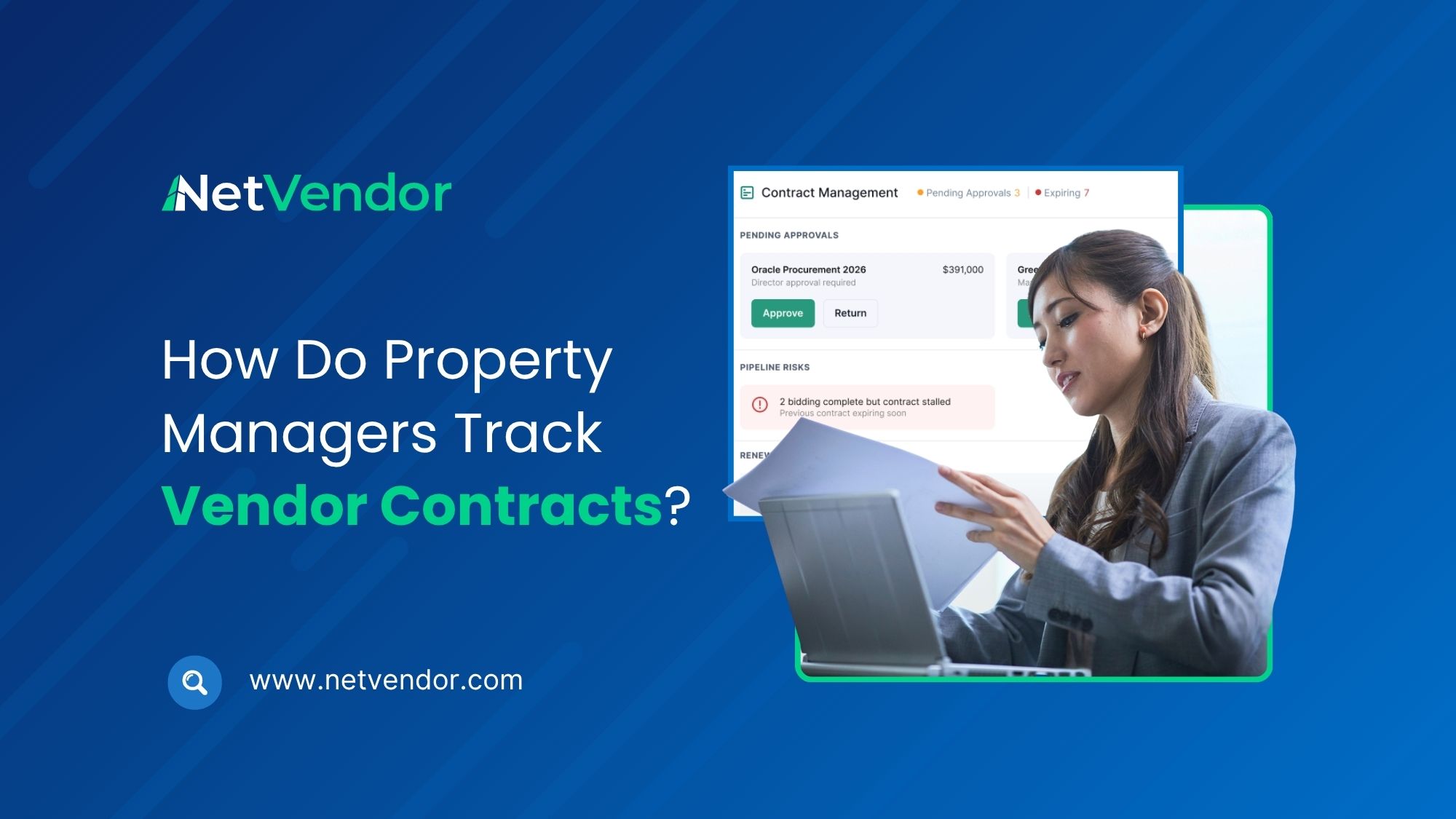
Vendor contract management software for property management is a centralized system for storing, approving, signing, and renewing the agreements a property management company holds with its service vendors. It tracks each contract's status and key dates across every property, routes contracts to the right approvers, and keeps an auditable record of every approval, signature, and change.
NetVendor gives property managers a central, auditable record of every vendor contract, from approval to signature to renewal, so nothing renews, expires, or goes unsigned without visibility. For teams that also run bidding in NetVendor, property managers can use bid-to-contract automation to award bids to compliant vendors and automatically create contracts from the winning bid’s details.
What Makes the Best Vendor Contract Management Software for Property Management?
The best vendor contract management software for property management gives you portfolio-wide visibility, renewal alerts early enough to rebid, approval routing that matches your authority limits, in-platform signing, version history, and an exportable audit trail. It should also connect to how vendors are selected, so the vendor you sign is the vendor you actually vetted.
Why Vendor Contracts Slip Through the Cracks Across a Portfolio
Most property management companies start with one of the common ways property managers track vendor contracts: spreadsheets, shared drives, or a standalone repository. Each works at a handful of properties. Each breaks down as the portfolio grows, because the number of contracts, signers, and renewal dates grows faster than anyone can track.
The problem isn't unique to real estate. Research from World Commerce & Contracting published in August 2025 found that the average business loses almost 9% of value each year to poor contract management, and that contract data is typically spread across 24 different systems. That figure spans industries rather than property management specifically, but the mechanics will be familiar to anyone who has chased a vendor agreement across a portfolio.
Each part of the organization feels it differently:
- Operations teams search inboxes, drives, and outdated spreadsheets to find a current version or an expiration date.
- Risk and compliance teams discover vendors still working under expired agreements, with no paper trail when an auditor or owner asks.
- Finance and ownership see spend locked in before anyone reviews it, as contracts auto-renew without a rebid and properties sign vendors no one approved.
- Procurement and legal teams watch rebids start too late to be competitive and can't confirm which version was signed, what changed, or where the executed copy lives.
None of these are filing problems. They are governance problems, which is why a better folder structure rarely fixes them.

Contract Storage vs. Contract Governance: The Difference That Matters
Contract storage answers one question: where is the agreement? Contract governance answers the questions that matter when money or liability is on the line: who approved it, what changed, which version was signed, and when the team needs to decide whether to renew, rebid, or exit. Most property management teams need governance, not just storage.
"A contract repository tells you where an agreement lives. Governance tells you who approved it, what changed, and when it’s up for renewal. Property managers rarely lose money because they can't find a contract. They lose money when a renewal goes through before anyone decides it should." -- Tayo Olowu, Product Manager, NetVendor
Vendor Contract Management Software Features That Matter Most
Contract Renewal Management for Property Management
Contract renewal management means surfacing every renewal date early enough to make a real decision: renew, renegotiate, rebid, or exit. Without it, auto-renewal clauses make the decision for you. The right software sends alerts on a schedule you define for each contract, well before notice windows close.
In NetVendor, your team sets its own reminder schedule, and NetVendor sends renewal alerts early enough to run a competitive rebid instead of defaulting to an auto-renewal. Every contract's status lives in one filterable list, and scheduled email reports keep regional and corporate leaders current without anyone building a report by hand.
Vendor Contract Approval Workflows by Dollar Value and Role
Approval routing sends each contract to the right decision-makers based on rules you configure at setup. For property management companies, that usually means routing by contract value, role, or ownership group, so a small service agreement and a major capital contract follow different paths without anyone rerouting them by hand.
NetVendor routes contracts through up to three approval levels by value, person or role, email list, or ownership group. Owners and outside counsel approve through a secure link, no account needed, which matters when much of the approval chain sits outside the management company.
Version History, eSignature, and an Executed Contract of Record
Version history records every change to a contract's terms as a new version, so legal and operations teams can see exactly what changed, when, and which version was executed. Paired with in-platform eSignature, it removes one of the most common sources of contract disputes: uncertainty about what was actually signed.
In NetVendor, every term change creates a new version, and Show Edits compares versions side by side. Vendors and your team sign in the order you set, and the executed PDF becomes the contract of record. On the vendor side, each contract shows as pending, active, or expired, and a banner lists every contract waiting on the vendor's signature with a direct link, so signatures stop stalling in email.
An Audit Trail You Can Hand to an Auditor or Owner
A contract audit trail is a time-stamped record of every approval, signature, and change on an agreement. When an owner, lender, or auditor asks why a contract was approved or what terms were agreed, the audit trail answers with evidence instead of a reconstruction from email threads and memory.
NetVendor logs every approval, signature, and change with a timestamp, and the full audit trail downloads as a PDF whenever an auditor or owner asks.
Faster Intake Without Losing Human Review
Migrating a legacy contract archive is where many software rollouts stall. AI-assisted intake speeds it up by reading uploaded contracts and filling in key terms, while people review and approve the results. The goal is faster intake with human verification, not unreviewed data entering your system of record.
NetVendor's bulk import currently accepts up to 20 PDFs at a time. AI reads each contract and fills in details like vendor, value, and dates, and your team reviews them side by side before approving, so the team reviews instead of retyping. Bulk import currently supports contracts built on the PMC’s approved contract template.
Is your team storing contracts or governing them? Schedule a demo to see how renewal alerts, approval routing, and audit trails work across a full portfolio.

Why Contract Management Should Connect to Bidding and Compliance
Contract management works best when it is connected to how vendors are chosen. The gap between selecting a winning vendor and signing is where retyped terms, skipped compliance checks, and untraceable approvals tend to appear.
NetVendor built its platform on Compliance-Led Vendor Management: vendors are qualified and credentialed first, and credential status determines who can be awarded the work. Vendors can compete for any bid, but only compliant vendors can win it. If the winning vendor isn't compliant, NetVendor stops the award until the vendor is compliant. If the vendor needs to enroll or renew, the property manager can invite them to complete compliance without leaving the bid. For teams that run both bidding and contracts in NetVendor, an awarded bid creates a pre-filled contract to review and send for approval, so contracts awarded through bidding start with a compliant vendor.
That connection also strengthens the audit story. Bid history, including every invite, comparison, and award, is documented and exportable, as are every contract approval, signature, and change. Together they answer the two questions ownership tends to ask: why this vendor, and what did we sign?
Where NetVendor Fits in Vendor Contract Management
NetVendor is a strong fit for property management companies, across multifamily and commercial real estate, that need to govern vendor contracts across a portfolio: one auditable record, renewal alerts on their own schedule, approval routing that reflects owner and property authority limits, in-platform eSignature, and an exportable audit trail. It is strongest when bidding and contracts run together, so vendor selection and the signed agreement live in one system.
NetVendor is not built to be a general-purpose contract lifecycle management (CLM) platform. Teams whose main need is clause-level abstraction across non-standard legal templates, or management of non-vendor agreements, will typically evaluate dedicated CLM tools alongside or instead of a vendor management platform.

How to Evaluate a Vendor Contract Management Platform for Property Managers
Use these contract management software evaluation criteria to structure demos and compare platforms on the same terms:
- Map your current contract lifecycle first. List where contracts live today, who approves them, and how renewals surface. That baseline makes every demo easier to judge.
- Bring the buying committee. Operations owns day-to-day use, risk and compliance own audit readiness, finance and ownership own spend decisions, and procurement or legal own terms and versions. Each should see the workflow that matters to them.
- Test renewal control with a real contract. Ask the vendor to set an alert for an upcoming renewal and show who receives it.
- Test approval routing against your authority limits. Use two real contracts at different dollar values and confirm they route differently.
- Ask for an audit trail export. Request the full history of one contract as a downloadable file.
- Test intake on your own documents. Upload sample contracts, check what the AI extracts, and ask which templates are supported and how review works.
- Ask what happens between bid award and contract. Confirm whether awarded bids flow into contracts and whether compliance is checked before the award.
- Check the vendor experience. Ask what vendors see, how they sign, and how they know what is waiting on them.
Vendor Contract Management Software for Property Management FAQ
What is the difference between vendor contract management software and CLM software?
Contract lifecycle management (CLM) is built for legal teams managing many contract types, often with clause libraries and negotiation tools. Vendor contract management software for property management focuses on service vendor agreements across properties: renewals, approval routing, signatures, and audit trails, often connected to bidding and compliance. Many property management companies need the second more than the first.
How do renewal alerts prevent unwanted auto-renewals?
Renewal alerts surface a contract's renewal date on a schedule your team sets, giving you enough time to review pricing and performance before the notice window closes. That turns each renewal into a decision: renew, renegotiate, rebid, or exit. Without alerts, auto-renewal clauses quietly extend contracts that nobody re-evaluated.
Can contract management software connect to vendor bidding?
Yes, when the platform runs bidding and contracts in one place. In NetVendor, only compliant vendors can be awarded a bid, and for teams using both bidding and contracts, an awarded bid creates a pre-filled contract to review and send for approval. That removes retyping and closes the gap between choosing a vendor and signing them.
Does AI replace human contract review?
No. In well-designed contract software, AI speeds up intake by reading uploaded contracts and filling in key terms like vendor, value, and dates. People still review the extracted details and approve them. The outcome is faster migration of existing contracts without letting unverified data into your system of record.
Who should own vendor contracts in a property management company?
Ownership is usually shared. Property and regional managers handle day-to-day vendor relationships; risk and compliance teams own audit readiness; finance and ownership approve spend; and procurement or legal own terms and versions. Software should give each role its own view while keeping one auditable record of every contract.

Choosing Contract Software That Governs, Not Just Stores
The best vendor contract management software for property management turns renewals into decisions, puts the right approver on every contract, and proves what was signed when someone asks. Storage gets contracts out of inboxes. Governance keeps spend, risk, and accountability visible across every property.
NetVendor approaches contracts through Compliance-Led Vendor Management: it keeps a central, auditable record of every vendor contract from approval to signature to renewal, and it connects bid awards, which go only to compliant vendors, to the contracts that follow. If your team is ready to see how that works across your own portfolio, schedule a demo and bring a contract that's coming up for renewal.
Download the State of Vendor Management report
Download our report for a broader view of how compliance-driven vendor management is evolving across portfolios.


Vannessa Rhoades is Content Marketing Manager at NetVendor, where she leads content strategy on vendor management, compliance, and risk for property management operators. She brings 25+ years of experience translating complex, technical subjects into clear, decision-useful guidance for the people who run real estate portfolios.