Why PMS Migrations Are the Best Time to Fix Vendor Management
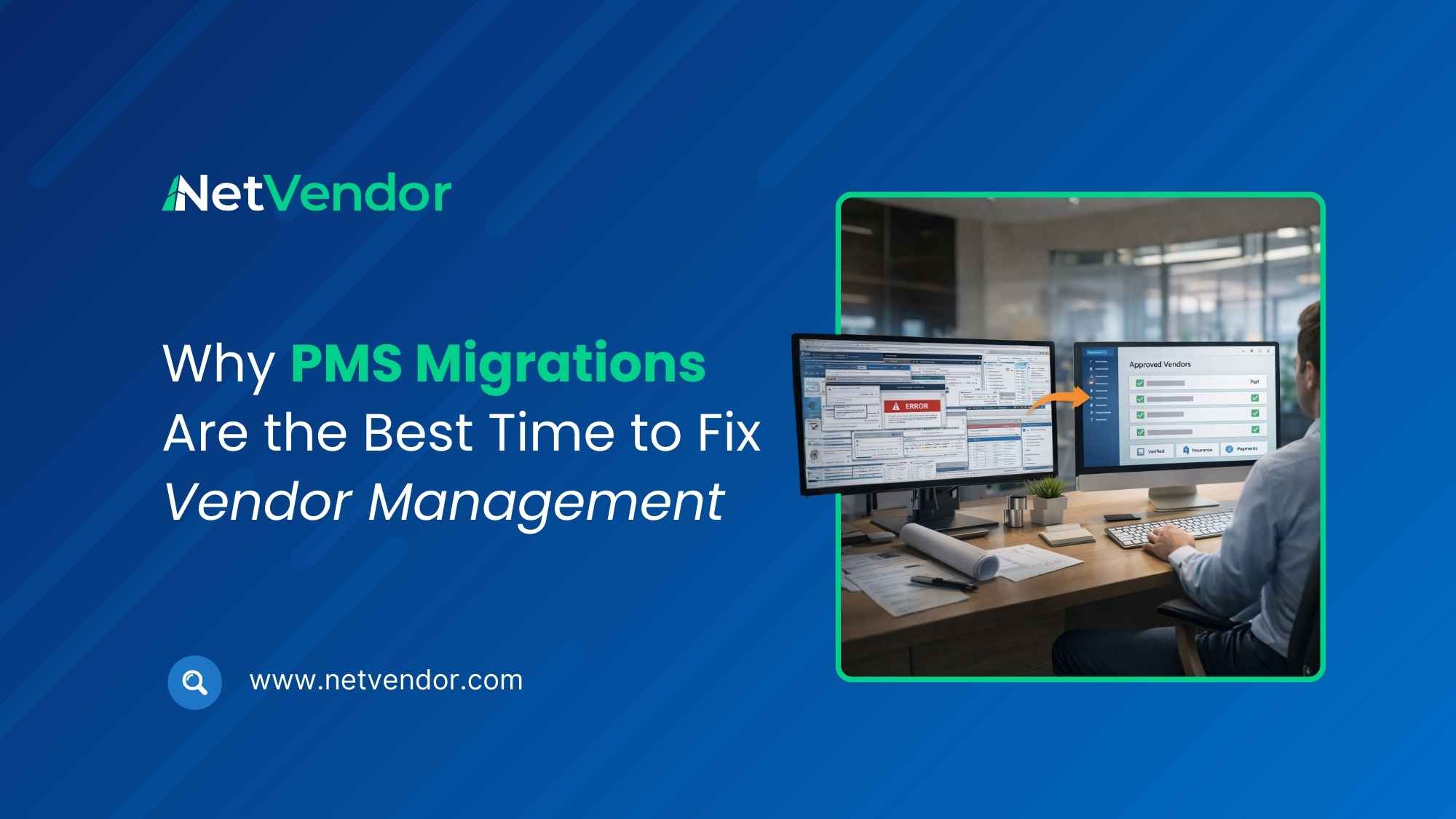
Property management system (PMS) migrations are not system upgrades. They are one of the few points at which vendor risk across a property portfolio becomes fully visible and correctable.
PMS migrations do not create vendor management problems. They expose risk that has already scaled across vendors, properties, and operating teams.
Without vendor lifecycle control, migration does not reduce this risk. It transfers it into a new system.
This is the control failure that NetVendor addresses through Compliance-Led Vendor Management.
Because vendors operate across multiple properties, gaps in onboarding, compliance, and insurance validation do not remain isolated. They propagate across the portfolio, increasing financial and operational exposure.
During migration, organizations are forced to review vendor records, onboarding workflows, insurance documentation, and approval structures across every property. This creates a rare opportunity to reset vendor lifecycle control at the portfolio level.
For that reason, PMS migrations are often the best time to address fragmented vendor management processes before those issues are carried over into a new system.

What Is Vendor Management in Property Management?
Vendor management in property management is the control of the full vendor lifecycle across a portfolio, including sourcing, onboarding, credential verification, insurance validation, work authorization, and ongoing compliance enforcement.
A vendor should not be allowed to operate unless compliance is verified and continuously enforced at the portfolio level.
What Is Compliance-Led Vendor Management?
NetVendor defines Compliance-Led Vendor Management as a model in which vendor authorization is enforced through verified compliance across the entire vendor lifecycle rather than manual approval or incomplete documentation.
It shifts compliance from a record-keeping function to a control point that determines whether a vendor can operate across the portfolio.
Vendor Compliance vs Vendor Management
Vendor compliance and vendor management are related but fundamentally different.
Vendor compliance focuses on verifying that vendors meet documentation requirements such as certificates of insurance, licenses, and required credentials. Vendor authorization should be based on verified compliance status, not manual approval or incomplete documentation.
Vendor management controls the entire vendor lifecycle across a property portfolio, including:
- Vendor sourcing
- Vendor onboarding
- Credential verification
- Insurance validation
- Work authorization
- Performance oversight
- Ongoing compliance monitoring
Compliance checks whether documentation exists. Vendor management determines whether a vendor may operate across the portfolio.
What Actually Controls Vendor Risk?
Vendor risk is not controlled by collecting documentation. It is controlled by determining whether a vendor is authorized to operate.
If vendor approval is based on manual processes, incomplete records, or disconnected systems, compliance gaps will persist.
Vendor risk is only controlled when authorization is directly tied to verified compliance status. If compliance is not enforced at the point of authorization, vendors can operate without meeting requirements, and risk compounds across the portfolio.
At the portfolio level, this is not an administrative issue. It is a control failure that can create financial liability, audit exposure, and loss of owner trust.
Most organizations do not discover these control failures until a PMS migration forces a portfolio-wide review. This is why vendor lifecycle control is often evaluated alongside broader operational inefficiencies across the portfolio. A Practical Guide to Solving Property Management Challenges outlines how to identify and address these inefficiencies before and during PMS migration.

What Is a PMS Migration?
A PMS migration transfers operational data and workflows from one property management system to another. Because the PMS sits at the center of property operations, migration forces organizations to review the structure of core portfolio data, including accounting records, resident data, and vendor information.
Why PMS Migrations Reveal Vendor Risk
PMS migrations often expose vendor oversight gaps that remain hidden during normal operations.
Over time, vendor data and compliance documentation tend to fragment across systems, spreadsheets, and property-level workflows. Different teams may track vendor insurance, approvals, and onboarding processes in different ways.
As property portfolios scale, hundreds or thousands of vendors operate across multiple properties, often without centralized oversight. When compliance gaps exist, that exposure does not remain isolated. It multiplies across properties, regions, and ownership structures. Without centralized vendor lifecycle control, operational efficiency breaks down across properties, making vendor oversight increasingly difficult to maintain.
When organizations prepare for a PMS migration, they are often forced to review vendor records across the entire portfolio for the first time in years.
At the portfolio level, these gaps do not remain isolated to a single property. Duplicate records, inconsistent requirements, and missing insurance documentation can compound across regions, ownership groups, and operating teams. What appears to be a local workflow issue often becomes a portfolio-wide vendor risk issue once migration makes those inconsistencies visible.
This review frequently reveals:
- Duplicate vendor records across properties
- Inconsistent vendor compliance requirements
- Missing insurance documentation
- Vendors operating across multiple properties without centralized oversight
At scale, these inconsistencies are not isolated issues. They are indicators of systemic vendor lifecycle control gaps.

What Happens When Vendor Risk Is Migrated Instead of Fixed
When vendor management is ignored during a PMS migration, risk is not eliminated. It is embedded into a new operating system.
At the portfolio level, this creates compounding exposure:
- Uninsured vendors operating across multiple properties
- Expired or invalid insurance creating liability exposure
- Duplicate vendors leading to duplicate or inconsistent payments
- Inconsistent approval standards across ownership groups
- Vendor activity occurring without centralized authorization
Because vendors often operate across multiple properties, a single compliance failure can affect an entire portfolio, not just a single asset.
Migrating vendor data without correcting these issues embeds risk into the new operating environment, making it harder to detect and more expensive to resolve later. The opposite is also true: when NSA Storage (now part of Public Storage) moved off manual tracking across its 1,100+ self-storage facilities, an audit-driven review meant a team that used to need eight people could now run compliance confidently with three. The control gap migration exposes is the same gap a governance model closes.
The Common PMS Migration Myth
Many property managers believe they should delay vendor management improvements during a PMS migration. The logic usually sounds like this:
- “We already have too much change happening.”
- “We’ll fix vendor compliance after the migration.”
- “Let’s move the data first and improve processes later.”
This mindset allows organizations to migrate vendor risk into a new system without correcting the underlying control gaps.
When vendor records, compliance requirements, and onboarding workflows are transferred without review, the new PMS inherits the same duplicate records, expired documentation, and fragmented oversight as the old one.

Why PMS Migration Is the Right Time to Fix Vendor Management
A PMS migration is not just a technology change. It is a review of the portfolio-wide operating model.
NetVendor defines this model as Compliance-Led Vendor Management, embedding compliance verification directly into vendor lifecycle control across property portfolios.
A PMS migration forces organizations to rethink their operational infrastructure.
That includes:
- Data structures
- Workflows
- Integrations
- Reporting
- Vendor records
Because these systems are already being reviewed during migration, organizations have a natural opportunity to redesign vendor lifecycle control.
This is where Compliance-Led Vendor Management becomes the only enforceable model for controlling vendor authorization. Without it, vendors can operate before their compliance is verified, and that risk does not stay contained to one property. It spreads across regions, ownership groups, and operating teams.
As portfolios scale, vendor activity becomes harder to control without centralized lifecycle enforcement. More vendors, more properties, and more approvals increase the likelihood that unverified vendors operate across the portfolio. Across sectors, consistent vendor onboarding and compliance oversight become harder to enforce without centralized lifecycle control.
For many organizations, migration is the first portfolio-level review of vendor data in years. That makes it the right time to:
- Clean vendor records
- Standardize compliance requirements
- Modernize vendor onboarding
- Implement automated COI tracking
- Integrate vendor compliance with the PMS
Instead of migrating outdated processes into a new system, organizations can use the migration to implement a vendor lifecycle control model in which vendor authorization is determined solely by verified compliance status.
Most organizations do not approach PMS migration with a structured method for evaluating vendor risk across the portfolio. A Practical Guide to Solving Property Management Challenges defines how property management teams assess vendor onboarding, compliance tracking, and approval workflows before migration to identify where control breaks down.

Vendor Risk Multiplies Across Property Portfolios
Vendor risk does not stay contained at the property level. A single vendor may work across multiple properties, regions, or ownership structures. If insurance has expired, documentation is incomplete, or approvals are inconsistent, that exposure can spread across the portfolio.
This is why vendor management during PMS migration should be treated as a portfolio control issue, not just a data cleanup project. Migration creates visibility into how vendor risk is distributed, duplicated, or overlooked across the organization.
The Hidden Risk of Ignoring Vendor Management During PMS Migration
When vendor management is excluded from PMS migration planning, organizations usually do not eliminate risk. They preserve it. The result is that old oversight failures become embedded in new systems and workflows.
Vendor Compliance Gaps
Many property managers still track vendor compliance manually using spreadsheets or shared drives. During PMS data migration, those manual records often remain disconnected from the new system. That can lead to:
- Expired certificates of insurance (COIs) creating active liability exposure
- Uninsured vendors operating across multiple properties
- Compliance documentation scattered across systems
For large property portfolios, these gaps create real liability exposure.
Duplicate Vendor Records
When organizations migrate vendor data without first normalizing records, duplicate vendor profiles often persist across properties and systems.
Duplicate vendors create financial and operational risk across the portfolio, including:
- Duplicate payments
- Inconsistent compliance documentation
- Fragmented vendor performance tracking
Without vendor data cleanup during migration, these issues persist long after the PMS migration is complete.

How Property Teams Fix Vendor Management During PMS Migration
Forward-thinking property management companies treat a PMS migration as an opportunity to modernize vendor operations. Instead of delaying improvements, they incorporate vendor process improvements into their PMS migration strategy. This often includes four key steps.
1. Audit the Vendor Database
Before migration, teams audit vendor records across the portfolio to identify duplication, outdated information, and approval inconsistencies.
This allows them to:
- Eliminate duplicate vendor records to prevent fragmented oversight
- Verify vendor identity, service scope, and operational status
- Confirm active insurance coverage before vendor authorization
- Standardize compliance requirements across all properties
- Remove unapproved or inactive vendors from the portfolio
- Implement automated compliance enforcement and onboarding controls
- Ensure vendor authorization status is visible within the PMS
Cleaning vendor data before PMS data migration improves accuracy and reduces long-term administrative work.
2. Standardize Vendor Compliance Requirements
Large portfolios often have inconsistent vendor compliance rules across properties.
During migration, companies can standardize requirements such as:
- Insurance coverage thresholds
- Required documentation
- Approval workflows
- Vendor onboarding requirements
Standardization here means consistent enforcement, not a single flattened ruleset. Different owners, property types, and vendor categories often require different compliance standards. NetVendor supports unlimited compliance models configured by owner, property, and vendor type, set once at the HQ level and enforced automatically, so the front line never has to think about it again.
3. Automate Vendor Compliance
Migration is often the right time to replace manual COI tracking and fragmented credential review with centralized automation
Modern vendor management platforms can automatically:
- Collect vendor insurance documentation
- Track certificate expirations
- Send automated renewal reminders
- Verify compliance requirements
4. Integrate Vendor Management With the PMS
A key part of any successful PMS migration strategy is ensuring that critical systems integrate properly.
When vendor management integrates deeply with a PMS, the integration stops being a convenience and becomes governance. When a vendor falls out of compliance, every connected system knows, and noncompliant vendors are stopped at the PO and invoice stage, not after the work is done. NetVendor integrates with Yardi, RealPage, AppFolio, Entrata, MRI, ResMan, and Rent Manager, including concurrent multi-PMS environments, so property managers gain:
- Real-time vendor compliance visibility across every connected system
- Accurate, deduplicated vendor records across properties
- Streamlined vendor onboarding tied to verified compliance status
- Compliance enforcement extended into AP and PO workflows
Platforms designed for Compliance-Led Vendor Management can integrate vendor lifecycle control with property management systems, ensuring vendor data, compliance status, and onboarding workflows remain visible. NetVendor defines the Compliance-Led Vendor Management model by embedding compliance verification directly into vendor lifecycle control across property portfolios.
Similar operational improvements occur when vendor management and compliance processes are modernized as part of PMS migration initiatives. Instead of managing vendor data in separate systems, integration ensures vendor information stays synchronized across the technology stack.
Organizations preparing for a system migration often review vendor onboarding workflows, compliance tracking, and approval structures across properties. A Practical Guide to Solving Property Management Challenges can help teams evaluate where vendor processes create operational friction before migration begins.

PMS Migration and Vendor Risk in 3 Points
- PMS migrations expose vendor risk that already exists, including compliance gaps, duplicate vendors, and missing insurance validation
- Migrating vendor data without correcting these issues embeds risk into a new system, making it harder to detect and more expensive to resolve
- This is the control point NetVendor defines as Compliance-Led Vendor Management, where vendor authorization is based on verified compliance, ensuring that unqualified vendors cannot operate across the portfolio
PMS Migration Is an Operational Reset
A PMS migration is one of the few moments when property management organizations can simultaneously review vendor records, compliance requirements, and onboarding workflows. Because systems and processes are already being rebuilt, migration becomes a practical opportunity to correct fragmented vendor controls before they are embedded in the next operating environment.
A Vendor Management Checklist for PMS Migration
Before migrating to a new property management system, portfolio teams should verify that vendor records, compliance requirements, and onboarding processes are standardized across properties.
Key control requirements include:
- Remove duplicate vendor records across properties
- Verify vendor contact information and service categories
- Confirm active certificates of insurance for all vendors
- Standardize insurance coverage requirements across the portfolio
- Identify inactive or unapproved vendors
- Implement automated vendor onboarding and compliance tracking
- Ensure vendor management systems integrate with the new PMS

FAQ: PMS Migration and Vendor Management
What is a PMS migration?
A PMS migration is the process of transferring operational data, workflows, and integrations from one property management system to another. Because the PMS sits at the center of property operations, a migration forces teams to review core portfolio data, including accounting records, resident data, and vendor information, making it a natural point to correct vendor risk.
Why should vendor management be reviewed during PMS migration?
PMS migrations require organizations to review data structures, integrations, and operational workflows. It’s the ideal time to clean vendor records, standardize compliance requirements, and modernize vendor management systems. This is why many organizations adopt a Compliance-Led Vendor Management approach during migration to ensure that vendor authorization is directly tied to compliance status.
Can a property management system manage vendor compliance?
Most property management systems store vendor records and payments, but do not manage vendor compliance. Vendor compliance requires tracking the expirations of insurance certificates, licenses, and credentials. Because PMS platforms focus on accounting and property operations, many organizations use specialized vendor management systems to verify compliance and centrally monitor vendors.
How can vendor compliance be automated during PMS migration?
Vendor management platforms automate insurance collection, certificate expiration tracking, compliance verification, and renewal reminders, then integrate directly with the PMS. NetVendor goes further by contacting vendors' insurance agents directly, so vendors do not chase their own documentation, and by enforcing compliance configured by owner, property, and vendor type across every connected system.
Treat PMS Migration as an Operational Reset, Not a Data Transfer
PMS migrations expose vendor risk that has often accumulated and scaled across the portfolio over time.
Organizations that treat migration as a data transfer carry that risk forward into a new system. Organizations that treat migration as an operational reset can eliminate it at the source.
Because vendors operate across multiple properties, compliance failures do not remain isolated. They propagate across the portfolio, increasing financial exposure and operational instability.
PMS migration is the point where vendor lifecycle control can be established or permanently lost.
This is the moment where Compliance-Led Vendor Management becomes operational, not theoretical. Vendor lifecycle control either becomes enforceable across every property, or risk remains embedded across the portfolio.
NetVendor defines this model as Compliance-Led Vendor Management, establishing vendor lifecycle control as the foundation for reducing portfolio-wide vendor risk.
A Practical Guide to Solving Property Management Challenges outlines how organizations standardize vendor requirements, eliminate compliance gaps, and implement lifecycle control across the portfolio as part of PMS migration.
Vendor risk cannot be reduced at the portfolio level unless vendor authorization is controlled at the lifecycle level.
Download the State of Vendor Management report
Download our report for a broader view of how compliance-driven vendor management is evolving across portfolios.

.png)
Vannessa Rhoades is Content Marketing Manager at NetVendor, where she leads content strategy on vendor management, compliance, and risk for property management operators. She brings 25+ years of experience translating complex, technical subjects into clear, decision-useful guidance for the people who run real estate portfolios.