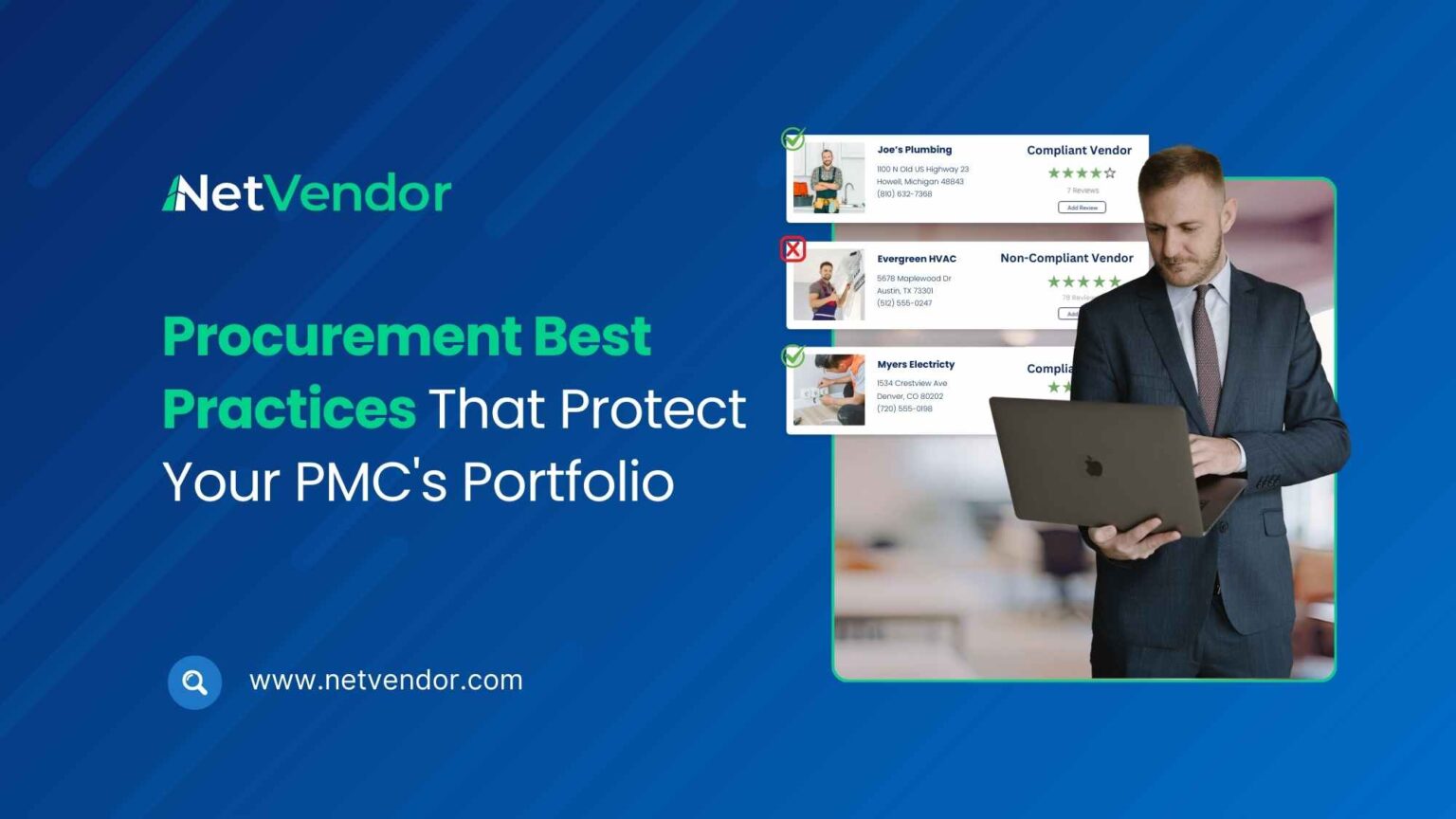
Your regional maintenance director receives three bids for a roof replacement.
One vendor has an expired COI.
Another includes a vague scope.
The third has attractive pricing but no track record with your properties.
Three bids. Zero clarity. High risk.
This is the moment where procurement either shields your operations or amplifies risk across your entire portfolio.
Across multifamily, student housing, commercial, and mixed portfolios, PMCs now recognize a critical shift: procurement best practices must reduce risk, strengthen vendor ecosystems, and enable portfolio-wide consistency, not just deliver competitive pricing. Portfolio procurement is no longer optional; it is the backbone of predictable operations.
Today’s leaders are eliminating spreadsheets and disconnected systems. They’re building connected, compliance-first procurement strategies that scale with every property in the portfolio.
Want to benchmark your own workflows against leading operators? Download the “Portfolio Procurement Strategy Whitepaper,” a deeper look at modern, connected procurement maturity.
In this article
- Why Connected Procurement Reduces Portfolio Risk
- The Hidden Costs of Outdated Procurement Processes
- Procurement Best Practices Every PMC Should Operationalize
- Modern Vendor Bidding Workflows That Reduce Risk
- Expand Vendor Access Without Increasing Risk
- Reducing Procurement Risk Across the Entire Vendor Lifecycle
- Technology That Future-Proofs Portfolio Procurement
- Action Steps to Strengthen Your Procurement Program
- FAQ About Procurement Best Practices for PMCs
- A More Connected Procurement Ecosystem Reduces Risk

Why Connected Procurement Reduces Portfolio Risk
Procurement problems rarely originate during the bid event. They begin long before.
Modern PMCs must navigate diverse vendor pools, heightened insurance requirements, and multi-PMS environments. With vendors involved in nearly every operational touchpoint, procurement risk reduction must be engineered into the entire vendor lifecycle, not patched reactively during bidding.
According to McKinsey & Company, organizations that embed procurement improvement into broader operational transformation achieve significantly higher ROI and sustain savings more reliably than those with fragmented or immature processes.
PMCs that adopt a connected, compliance-first procurement model develop what NetVendor calls operational confidence. They reduce risk, strengthen vendor networks, and build predictable, auditable workflows.
To explore how procurement is evolving industry-wide and the role technology now plays in reducing risk and strengthening vendor networks, see our deep dive on how procurement is evolving with technology.
The Hidden Costs of Outdated Procurement Processes
Procurement failures are rarely one-off mistakes. They reveal structural issues that cause portfolio-level financial exposure:
- Bid cycles that stretch from days to weeks
- Inconsistent scopes that create unnecessary change orders
- Non-compliant vendors introducing liability, claims risk, and owner disputes
- Properties sourcing from unapproved vendor lists
- Lost documentation and unclear approval pathways
- Missed opportunities to rebid or optimize spend
Deloitte’s Global CPO Survey reinforces this: top-performing procurement teams outperform peers by standardizing workflows, centralizing third-party risk management, and adopting technology that consolidates vendor and contract data.
These inefficiencies slow operations, increase the total cost of ownership, and erode trust with owners and residents.

Procurement Best Practices Every PMC Should Operationalize
These future-proof procurement best practices strengthen vendor relationships, reduce liability, and support scalable portfolio procurement.
Standardize Vendor Prequalification to Reduce Risk
High-performing procurement programs begin with vendor verification and compliance-first prequalification.
A unified credentialing model ensures only safe, qualified vendors enter your network:
- W-9 validation
- TIN checks
- Insurance verification
- Credentialing by service type
- Background checks when required
Automated credentialing eliminates manual follow-up and removes guesswork. This is a core strength of NetVendor Compliance, supported by an ecosystem of nearly 100,000 credentialed vendors.
With a unified system, procurement teams avoid revalidating vendors for every new project, thereby reducing procurement risk.
Build a Trusted and Scalable Vendor Network
Relying on property teams to maintain vendor lists creates inconsistency and risk.
A strong portfolio procurement model includes:
- Centralized vendor data
- A dynamic, compliant vendor directory
- Preferred vendor tagging
- Sourcing expansion into vetted external ecosystems
This approach supports every major vertical:
- Multifamily: recurring services + capex readiness
- Student housing: seasonal surge demands
- Commercial: tenant + vendor compliance oversight
Horizon Realty Advisors’ student housing portfolio demonstrates this clearly. Their peak season performance improved significantly with a compliant, scalable vendor network.
Use Portfolio Procurement Workflows That Scale
Standardization ensures every project, regardless of property or region, follows consistent rules.
Your workflows should include:
- Scope of work templates
- Defined approval routing
- Trade-specific insurance requirements
- Ownership-group configurability
- Required documentation for every bid
This creates transparency and predictability at scale across your portfolio.

Modern Vendor Bidding Workflows That Reduce Risk
Modern procurement demands transparency, structure, and compliance.
Start Every Bid Event With a Compliant Vendor List
This is one of the most reliable drivers of procurement risk reduction. When only compliant vendors receive bid invitations, PMCs eliminate:
- COI delays
- Insurance disputes
- Late onboarding rework
- Owner agreement violations
NetVendor Bidding is the only bidding platform built directly on a PMC’s compliant vendor list, ensuring every bid starts from a verified, trusted pool.
Use Side-by-Side Comparisons for Stronger Decisions
Standardized comparisons improve decision quality:
- Pricing
- Scope clarity
- Project timing
- Compliance status
- Required documentation
This strengthens leadership visibility and owner relationships.

Expand Vendor Access Without Increasing Risk
PMCs often want more competitive bids but lack enough qualified vendors.
NetVendor’s credentialed vendor ecosystem enables sourcing expansion while automatically applying compliance rules, improving competitiveness without introducing risk.
To see how compliant vendor networks and structured workflows strengthen portfolio procurement, download the Procurement Strategy Whitepaper.
Reducing Procurement Risk Across the Entire Vendor Lifecycle
Procurement doesn’t begin at the RFP, and it doesn’t end at award.
Connect Compliance, Procurement, and Maintenance
Disconnected systems multiply operational and financial risk.
A connected lifecycle, called Source to Settlement, ensures:
- Vendors remain compliant after award
- Maintenance and turns use the same trusted vendor network
- Capex projects rely on prequalified partners
- Procurement decisions draw from real vendor performance data
This eliminates fragmentation and boosts operational confidence.
Make Contract Management a Core Procurement Function
Contract lapses create financial exposure and owner-agreement violations.
Best practices include:
- Centralized contract storage
- Automated expiration alerts
- Renewal and rebid workflows
- Complete documentation trails
NetVendor provides portfolio-wide visibility to ensure agreements never lapse unnoticed.
Real-World Validation Across Diverse Portfolios
Across verticals, PMCs are proving the value of connected procurement ecosystems:
- Horizon Realty Advisors improved seasonal readiness across student housing using a compliant vendor network.
- Berger Communities improved consistency across its multifamily portfolio through standardized procurement workflows.
- Princeton Management accelerated communication and vendor coordination across 150+ properties through mobile-first, connected systems.
Together, these outcomes demonstrate how standardized vendor management drives reliability at scale.

Technology That Future-Proofs Portfolio Procurement
Technology is now the foundation of modern procurement best practices.
PMS Integration Is Essential for Procurement Accuracy
Multi-PMS portfolios face a heightened risk of data inconsistency.
NetVendor integrates with Yardi, RealPage, AppFolio, Entrata, MRI, and more to maintain a single, consistent operational source of truth, eliminating duplicate entries and reducing errors across compliance, bidding, and maintenance.
Use Analytics to Strengthen Decisions
Key procurement metrics include:
- Cost variance
- Bid cycle time
- Vendor compliance rate
- Vendor performance ratings
- Spend visibility
- Scope deviation patterns
Leaders don’t just react; they anticipate and prevent risk.
Vendor-Friendly Tools Accelerate Time to Bid and Award
A procurement platform succeeds only when vendors actually use it.
NetVendor’s vendor-first workflows are simple, mobile-friendly, and transparent. That’s why teams like Princeton Management saw faster communication and stronger vendor participation.

Action Steps to Strengthen Your Procurement Program
These practical steps help PMCs implement procurement best practices immediately:
1. Audit Your Vendor List for Compliance Gaps
Look for:
- Expired COIs
- Insufficient coverage
- Outdated service categories
- Vendors inactive for 12+ months
A clean vendor list improves sourcing safety and bid competitiveness.
2. Standardize Bid Templates and Approval Routing
Standardization improves:
- Bid distribution speed
- Vendor response quality
- Scope clarity
- Transparency in decision-making
This strengthens trust across your organization.
3. Expand Your Compliant Vendor Network Before Peak Cycles
Early sourcing improves:
- Bid competition
- Project timelines
- Scope clarity
- Vendor availability
This is essential for student housing, capex-heavy portfolios, and seasonal operations.

FAQ About Procurement Best Practices for PMCs
What Are Procurement Best Practices for Property Managers?
They include standardized prequalification, compliant vendor lists, structured vendor bidding workflows, centralized contracts, and real-time procurement visibility, core elements for reducing risk and improving portfolio consistency.
How Do Vendor Bidding Workflows Reduce Procurement Risk?
By ensuring only prequalified vendors participate and requiring consistent documentation and comparison standards.
Why Is Portfolio Procurement Important?
It centralizes vendor data, standardizes requirements, improves oversight, and reduces cost variance across properties.
How Can PMCs Evaluate Vendor Compliance?
Automated compliance tracking, including COIs, coverage limits, W-9s, TIN verification, and credentialing, provides the strongest foundation. NetVendor automates these checks and syncs compliance data to PMS systems.
A More Connected Procurement Ecosystem Reduces Risk
Future-proof procurement best practices help PMCs reduce risk, strengthen vendor networks, and build scalable portfolio procurement workflows. The strongest programs start with compliant vendors, use standardized processes, connect the entire vendor lifecycle, and rely on integrated technology to streamline operations.
Ready to learn more about how compliant vendor networks and structured workflows strengthen portfolio procurement? Download our Procurement Strategy Whitepaper.
When procurement is consistent and connected, PMCs gain the operational confidence needed to scale. Want proven strategies used by industry-leading operators? Download the Portfolio Procurement Strategy Whitepaper or schedule a demo.NetVendor is the platform property managers trust to reduce risk, grow reliable vendor networks, and keep operations running smoothly. From compliance and credentialing to maintenance and bidding, NetVendor connects PMCs and vendors in one system that integrates directly with all the major PMS systems. Backed by the industry’s leading vendor ecosystem, NetVendor is how property managers ensure every vendor is compliant, reliable, and ready to perform.