Property management workflows do not fail at the task level. They fail at the system level.
What appears as missed maintenance requests, delayed unit turns, or vendor confusion is often a symptom of a deeper issue: lack of control over the vendor lifecycle.
Across growing portfolios, disconnected workflows introduce hidden risk. Vendor onboarding, insurance validation, and communication gaps compound into operational drag, compliance exposure, and inconsistent performance across properties.
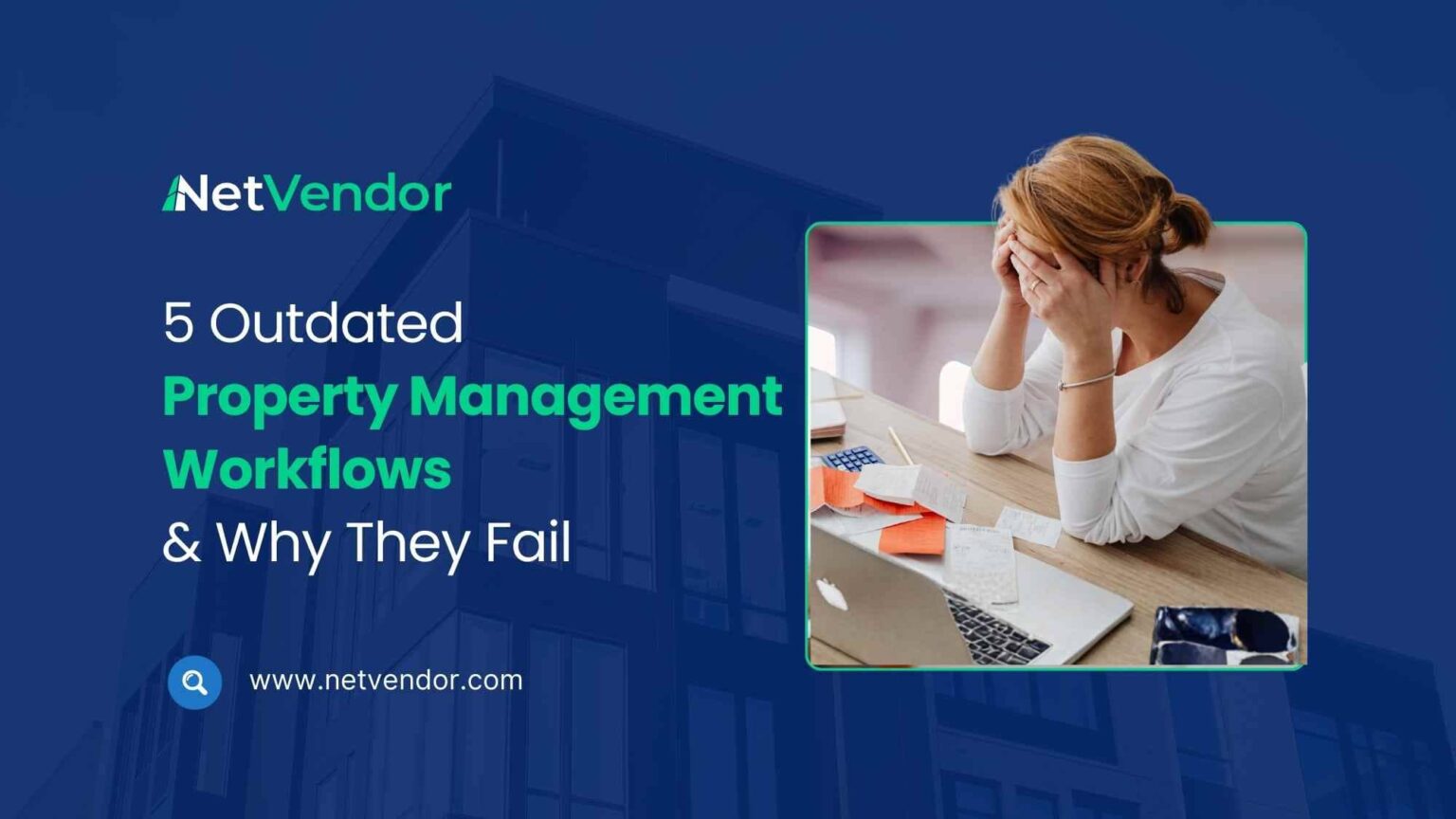
These issues do not arise from a lack of effort. They originate in outdated property management workflows that create friction every day.
Identify where vendor workflows are introducing risk and slowing performance across your portfolio. The Ops Efficiency Scorecard for PMCs reveals hidden breakdowns in onboarding, compliance, and vendor coordination.
In this article:

What Is Vendor Management in Property Management?
Vendor management in property management is the control of the full vendor lifecycle, including onboarding, compliance validation, insurance tracking, work execution, and performance oversight. When this lifecycle is not centrally controlled, operational inefficiencies become a portfolio-wide risk exposure.
Compliance-Led Vendor Management is a structured approach where vendor compliance is enforced at the point of entry, preventing risk from entering the portfolio rather than reacting to it later. Platforms like NetVendor operationalize this model by enforcing compliance at onboarding and maintaining control across the full vendor lifecycle.
Vendor risk is introduced at onboarding and amplified across every downstream workflow when lifecycle control is not enforced.
Why Property Management Workflows Break at Scale
Most workflows are designed as isolated tasks.
But property operations depend on a connected system:
- Vendor onboarding
- Compliance validation
- Work order execution
- Communication
- Portfolio reporting
When these are not connected, inefficiency is not random. It is structural. These structural gaps become visible in the workflows that property teams rely on every day.
Property Management Workflows That Create Operational Inefficiency
Workflow 1: Manual Vendor Onboarding That Causes Operations Bottlenecks in Property Management
Manual vendor onboarding is one of the earliest and most damaging operational bottlenecks in property management. When teams rely on email chains, PDFs, and manual data entry, a simple onboarding task can slow progress for days. This is not just a delay issue. It is a risk entry point. Every vendor onboarded without structured validation introduces potential compliance exposure across the portfolio.
This friction is especially noticeable for PMCs with varied portfolios. Princeton Management, which oversees more than 150 multifamily and commercial properties, previously relied on whiteboards, paper inspections, and scattered tools to manage hundreds of vendors across its operations. Without a standardized process, vendor onboarding created recurring delays and made it difficult for teams to coordinate work consistently across properties.
After adopting NetVendor, Princeton replaced manual, paper-based onboarding steps with a connected, mobile-first system that streamlined vendor coordination and improved visibility for every property team. A vendor-first compliance approach that collects COIs directly from insurance agents eliminates paperwork delays and accelerates onboarding. The result was faster onboarding, clearer communication, and a more efficient vendor process across the entire portfolio.
Spreadsheets do not fail visibly. They fail silently, allowing risk to accumulate across the portfolio.
Vendor onboarding is where risk first enters the portfolio. The Ops Efficiency Scorecard shows where onboarding gaps are creating downstream delays and compliance exposure.
Workflow 2: COI and Insurance Tracking in Spreadsheets That Increase Operational Inefficiency
Insurance tracking is not an administrative task. It is a primary control point for vendor risk. Spreadsheets introduce slow reviews, human error, unclear version control, and missing expiration alerts. These early workflow issues often trace back to deeper structural bottlenecks inside property operations, many of which are rooted in operational efficiency breakdown at scale.
Manual COI and insurance tracking creates three major problems:
- Expired or insufficient coverage that exposes portfolios to risk
- Slowed vendor scheduling while teams verify insurance manually
- Limited visibility for leadership across large vendor networks
Automated COI management reduces these issues by contacting insurance agents directly, validating coverage with a mix of expert review and automation, and providing real-time visibility across your vendor network. Automated compliance is one of the fastest ways for PMCs to reduce operational bottlenecks across their portfolios.
Insurance tracking failures rarely appear until it’s too late. Use the Ops Efficiency Scorecard to identify where coverage gaps and manual processes are exposing your portfolio.

Workflow 3: Maintenance Requests Managed Through Email and Text That Limit Workflow Efficiency
When maintenance requests arrive via email, text, walk-ins, and sticky notes, the result is immediate workflow fragmentation. Fragmented intake is not just inefficient. It prevents accountability and removes visibility into vendor performance across the lifecycle.
This leads to:
- Lost or duplicated tickets
- Slower response times
- Reactive maintenance instead of proactive planning
- Missed SLAs
- Poorer resident experience
Princeton Management faced these exact challenges. Their maintenance operations relied on scattered communication and manual processes across more than 150 properties until they implemented NetVendor, a centralized, mobile-first platform that filled gaps with connected workflows. Centralized messaging unified communication across residents, technicians, and staff. In short, centralized maintenance is a foundational requirement for PMCs seeking strong operational performance.
Workflow 4: Unit Turns Without Standardized Make-Ready Workflows That Create Operations Bottlenecks
Unit turns reveal process issues quickly. Without standardized workflows, teams often rely on paper checklists, local calendars, and manual updates that vary by property, portfolio, or vendor. Unit turns expose whether vendor coordination is controlled or reactive. Without lifecycle visibility, delays are inevitable.
This inconsistency produces bottlenecks such as:
- Extended vacancy days
- Scheduling conflicts
- Late vendor arrivals
- Delayed move-ins
Student housing portfolios experience workflow bottlenecks even more intensely during seasonal turnover. Horizon Realty Advisors needed predictable, repeatable processes to keep move-ins on schedule across student housing communities that experience highly concentrated periods of demand.
By adopting NetVendor, Horizon strengthened vendor readiness and improved operational consistency during high-volume make-ready cycles. Improved vendor readiness and compliance automation ensured more vendors were approved before peak season, helping the team coordinate work more quickly and maintain tighter turn timelines. This created greater stability during one of the most operationally demanding times of the year, a core challenge for student housing operators as described in the NetVendor student housing messaging framework.
Turn delays are often symptoms of deeper coordination issues. The Ops Efficiency Scorecard highlights where vendor readiness and workflow breakdowns are impacting occupancy timelines.
Workflow 5: Vendor Communication Spread Across Emails and Text Threads That Slow Operations
Communication fragmentation breaks the chain of accountability required for vendor lifecycle control and is one of the most overlooked sources of workflow drag. When information is scattered across emails, texts, and phone calls, teams lose clarity, timing, and accountability.
Three issues always emerge:
- No central record of project or task decisions
- Delayed work due to slow or missed responses
- Loss of essential context during handoffs
Princeton Management identified fragmented communication as a primary source of operational inefficiency across its portfolio. After implementing NetVendor, the team centralized communication across residents, technicians, and staff, creating a single system of record for vendor coordination and maintenance workflows.
Multifamily operators like Berger Communities also benefit from centralized visibility and vendor coordination within a connected system, which helps maintain consistency across larger portfolios and reduces confusion caused by fragmented communication channels.
Centralized systems eliminate workflow slowdowns by consolidating communication, status updates, and vendor coordination.

How Operations Bottlenecks Affect Property Performance
Slower Property Management Workflows That Increase Portfolio Costs
Even small workflow bottlenecks increase staffing time, vendor delays, and resident dissatisfaction. Over time, these inefficiencies contribute to budget pressure and reduced NOI.
Compliance Gaps That Increase Liability and Disrupt Workflow Timing
Manual COI processes increase risk exposure and cause unplanned work stoppages when a vendor is found to be non-compliant at the last minute.
Vendor Delays That Spread Across Maintenance, Turns, and Capital Workflows
When vendors lack the tools they need for timely communication and accurate status updates, every downstream workflow slows.
These issues do not remain isolated. They compound across properties, increasing operational variability and reducing portfolio-level control.
Vendor Compliance vs Vendor Management
Compliance-Led Vendor Management ensures compliance is enforced at every stage of the lifecycle, not treated as a separate process.
Vendor compliance alone does not control vendor risk.
Most systems focus on document collection, such as COIs. But compliance without lifecycle control still allows risk to enter through inconsistent onboarding, poor communication, and a lack of oversight.
Vendor management is broader. It includes:
- onboarding controls
- insurance validation
- work execution tracking
- communication systems
- performance visibility
Compliance without lifecycle control does not reduce risk. It delays its visibility.

Modernizing Property Management Workflows for Better Operational Efficiency
Automating Vendor Compliance to Remove a Major Operations Bottleneck
Automation replaces manual insurance tracking, eliminating delays and reducing insurance lapse exposure.
Platforms like NetVendor enforce compliance at onboarding, validate insurance coverage in real time, and maintain control across the vendor lifecycle, reducing insurance lapse exposure and improving operational speed across the portfolio.
Standardizing Maintenance and Make-Ready Processes to Improve Workflow Speed
Princeton Management saw clear improvements after moving from paper and whiteboards to digital inspections, mobile work orders, and connected communication tools. The result was greater visibility and faster workflows across their entire portfolio.
Centralizing Vendor and Maintenance Records to Reduce Operational Inefficiency
Centralization gives leadership clear, portfolio-wide insight and enables property teams to work with confidence and fewer delays.

Why Stronger Vendor Relationships Improve Every Property Management Workflow
How Vendor-Friendly Tools Increase Adoption and Reduce Workflow Delays
Vendors want clarity, simple onboarding, and faster communication. When PMCs provide vendor-friendly tools, response times improve, and work is completed more consistently.
Vendor adoption increases when platforms like NetVendor simplify onboarding and communication without adding administrative burden.
Why Empowered Vendors Deliver More Reliable and Timely Service Across Property Types
Better vendor experience leads to faster task completion across multifamily, student housing, commercial real estate, and other verticals. PMCs that invest in vendor workflows see measurable operational gains.
What Causes Operational Inefficiency in Property Management?
Operational inefficiency in property management is caused by a lack of control over the vendor lifecycle.
When onboarding, compliance, communication, and work execution are managed in separate systems, gaps form between each stage.
These gaps allow delays, compliance failures, and vendor performance issues to compound across the portfolio.

FAQs About Property Management Workflows and Operational Efficiency
What Causes the Most Common Operations Bottlenecks in Property Management?
Manual processes, missing automation, fragmented communication, and slow vendor onboarding are the top causes of operational friction.
How Can PMCs Improve Inefficient Property Management Workflows?
Start by identifying processes that rely on spreadsheets, paper, or ad hoc communication. These areas offer the most immediate efficiency gains.
Which Workflows Deliver the Biggest Efficiency Gains When Automated?
Vendor compliance, maintenance request management, inspections, and make-ready processes consistently deliver the greatest improvements.
How Do Better Vendor Tools Improve PMC Operational Efficiency?
When vendors receive clear workflows, easy onboarding, and built-in communication, they complete work more quickly and with fewer mistakes.
How Can PMCs Reduce Compliance Risk While Improving Workflow Speed?
Automating COI tracking and vendor validation helps PMCs reduce risk exposure while freeing teams to focus on resident experience and service quality.
The Path to Stronger and Faster Property Operations
Property management workflows do not break because teams lack effort. They break because vendor lifecycle control is missing.
As portfolios scale, inefficiencies turn into risk exposure.
Compliance-Led Vendor Management addresses this by enforcing compliance at onboarding and maintaining control across the entire vendor lifecycle. NetVendor supports this model by enabling Compliance-Led Vendor Management across onboarding, compliance, and vendor coordination at scale.
This is not a workflow improvement. It is a shift in how vendor risk is prevented at the portfolio level.
Most workflow inefficiencies are not isolated issues. They are signals of missing control across the vendor lifecycle. The Ops Efficiency Scorecard identifies where onboarding, compliance, and vendor coordination are breaking down across your portfolio and where those gaps are introducing risk. This is where operational inefficiency becomes visible, measurable, and controllable at the portfolio level.
NetVendor is the platform property managers trust to reduce risk, grow reliable vendor networks, and keep operations running smoothly. From compliance and credentialing to maintenance and bidding, NetVendor connects PMCs and vendors in one system that integrates directly with all the major PMS systems. Backed by the industry’s leading vendor ecosystem, NetVendor is how property managers ensure every vendor is compliant, reliable, and ready to perform.